

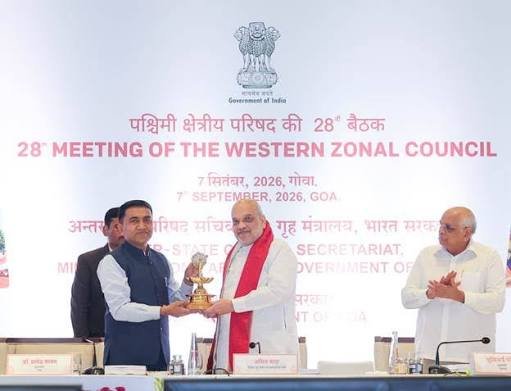
GTNS | September 7, 2026 Union Home Minister Amit Shah has underlined the growing importance of Zonal Councils in bringing states and the Centre together to address development challenges and issues affecting citizens.
Shah said the councils have evolved beyond being forums for administrative discussions and are increasingly becoming platforms where states can work collectively on matters of public welfare, infrastructure and regional development.
The emphasis on the councils comes against the backdrop of the government’s broader push for cooperative federalism, under which coordination between different levels of government is viewed as essential for delivering development programmes effectively.
Regional cooperation at the centre
India’s states often face challenges that extend beyond administrative boundaries. Issues involving transport, water resources, infrastructure, public safety and economic development can require cooperation between neighbouring states.
Zonal Councils provide a structured mechanism for governments to discuss such matters collectively and seek solutions through consultation.
According to Shah, this collaborative approach can help reduce delays and encourage states to work towards common regional objectives.
Focus on public welfare
The Home Minister has also linked the functioning of Zonal Councils with improvements in people’s lives.
Better coordination between states can support more effective implementation of welfare programmes and help governments respond to issues that affect communities across state borders.
The councils can also provide an avenue for sharing successful administrative practices, allowing one state to learn from the experiences of another.
Strengthening cooperative federalism
The renewed focus on Zonal Councils reflects the government’s effort to strengthen Centre-state coordination.
Rather than treating development as an issue for individual governments alone, the council mechanism encourages states to identify common priorities and work together.
Such coordination becomes particularly significant in regions where economic activity, migration, transportation networks and natural resources are closely interconnected.
Development with a regional perspective
India’s development requirements differ considerably from one region to another. A policy that works effectively in one part of the country may require adjustments elsewhere.
Zonal-level discussions allow governments to bring regional concerns directly into the policy dialogue.
This can help identify practical solutions based on local conditions while maintaining coordination with national development priorities.
A platform for problem-solving
The effectiveness of Zonal Councils ultimately depends on how successfully decisions taken through these forums are implemented.
Regular meetings can identify bottlenecks, but sustained follow-up by the concerned governments remains essential for converting discussions into measurable results.
Shah’s remarks place renewed attention on this institutional mechanism at a time when India’s development agenda increasingly requires cooperation across state boundaries.
The broader message is that development gains can be strengthened when governments treat regional challenges as shared responsibilities rather than isolated problems.