

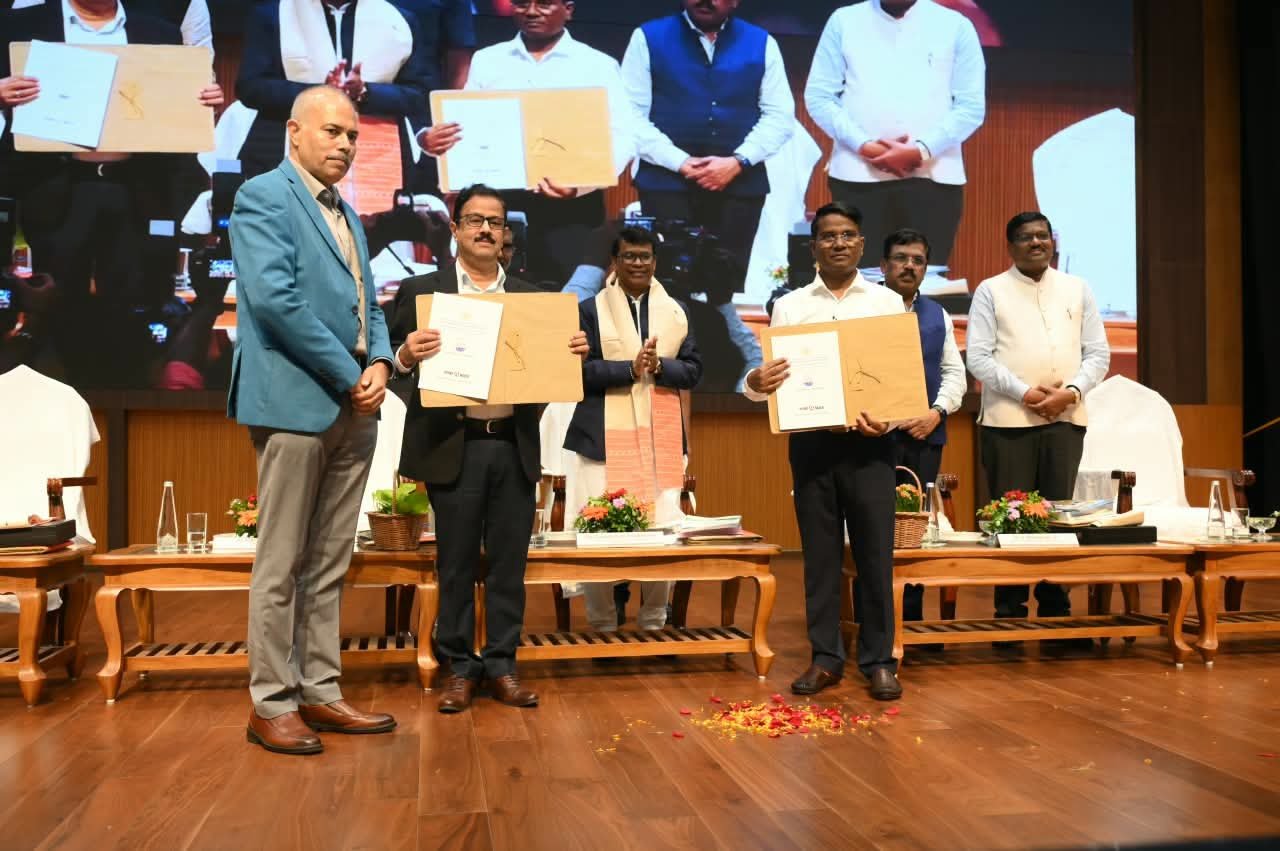
NALCO–State Pollution Control Board partnership opens a new track for environmental assessment, utilisation and technical capacity-building
BHUBANESWAR: Odisha has begun placing greater emphasis on what happens to industrial by-products after they are generated, with the State Pollution Control Board and NALCO Research & Technology Centre entering into a fresh collaboration on fly-ash management.
The Memorandum of Understanding was signed on September 18 during the 43rd Foundation Day programme of the Odisha State Pollution Control Board in Bhubaneswar. Forest, Environment and Climate Change Minister Ganesh Ram Singkhuntia was present at the programme, along with NALCO Director (Production) Pankaj Kumar Sharma and senior officials.
Rather than viewing fly ash only through the lens of disposal, the new cooperation is intended to create a stronger institutional framework around its assessment, utilisation and the technical knowledge required to manage it more effectively.
That distinction is important for an industrial state such as Odisha, where mining, power generation, metals and manufacturing create large streams of industrial material requiring scientific management.
NALCO already publishes periodic environmental information, including ash-utilisation data from its Alumina Refinery operations. Its August 2026 ash-utilisation status was posted on the company’s website earlier this month.
The new partnership therefore comes at a point when environmental management is increasingly moving beyond simply measuring pollution to finding practical pathways for reducing waste and increasing the productive use of industrial by-products.
The MoU is expected to support environmental assessments, beneficial utilisation of fly ash and training and capacity-building. The larger challenge will be translating those objectives into measurable outcomes across the industrial ecosystem.
Fly ash has applications in areas such as construction materials, cement-related production, bricks and other permitted forms of utilisation. Government environmental frameworks have for years encouraged greater utilisation rather than long-term accumulation. NALCO’s own environmental compliance documents also record efforts to increase ash utilisation and reporting to regulatory authorities.
For Odisha, the significance of the new arrangement consequently extends beyond the two institutions signing the agreement. The effectiveness of fly-ash management ultimately depends on the chain connecting generation, testing, storage, transportation, end-use industries, regulatory monitoring and compliance.
The timing is also notable because the Pollution Control Board has simultaneously begun adding technology to its environmental-monitoring system. A drone-based monitoring mechanism was launched during the same Foundation Day programme to strengthen surveillance of industrial activities, while an AI-enabled chatbot was also introduced.
Taken together, these initiatives indicate a broader shift towards technology-supported environmental governance in the state.
For the fly-ash programme, the next question will be implementation: how much ash can be productively utilised, where can it be safely and economically used, what environmental assessments are required, and how consistently can compliance be monitored?
Those questions will determine whether the new cooperation remains primarily an institutional agreement or develops into a practical model for converting an industrial by-product into a usable resource.
With NALCO bringing industrial and technical expertise and the State Pollution Control Board providing the regulatory and environmental framework, the partnership creates an opportunity to connect research, industry and environmental governance more closely.
The real measure of success will ultimately be visible not at the signing ceremony, but in the quantity of fly ash responsibly utilised, the quality of environmental monitoring and the reduction of long-term management pressures around ash generation and storage.
Global Times News | INDIA ; GTNS NEWS DESK
SEPTEMBER 20, 2026