
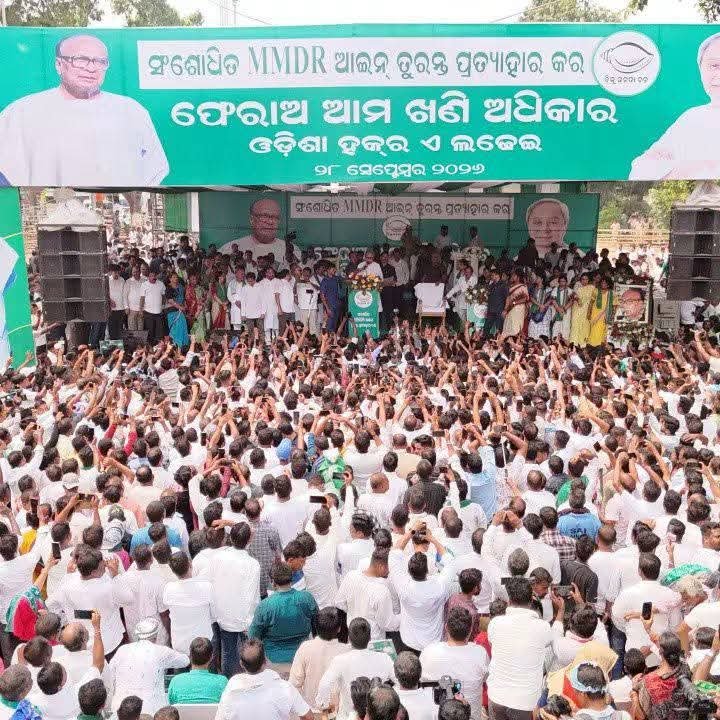
BJD president and Leader of Opposition urges all political parties to join the campaign against the MMDR changes
GTNSSEPTEMBER 28, 2026,
BHUBANESWAR: The political debate over Odisha’s share in mineral revenues has gained fresh momentum, with BJD president and Leader of Opposition Naveen Patnaik calling for a broader, united campaign to protect the state’s financial interests.Addressing the issue, Patnaik said the debate surrounding the Mines and Minerals (Development and Regulation) Act was not merely a matter for one political organisation. He appealed to political parties across the state to come together wherever they believe Odisha’s interests could be affected.At the centre of the controversy is the question of how changes in the legal framework governing mineral resources could affect the state’s revenue position.Patnaik puts Odisha’s financial interests at the centrePatnaik has argued that Odisha, as one of India’s major mineral-producing states, has a substantial economic stake in the way its natural resources are governed.According to the BJD leader, any reduction in the state’s potential mineral-related revenue could have consequences beyond government finances. He has linked the issue with the state’s ability to invest in infrastructure, welfare programmes, education, employment and other development priorities.The former chief minister has also expressed concern over what he describes as the possibility of Odisha losing thousands of crores of rupees in revenue.The figure being cited by the BJD is a political claim and remains subject to detailed assessment of the legal provisions and their actual financial impact.A dispute rooted in the Centre-State financial relationshipThe MMDR controversy has opened a larger discussion about the division of powers between the Union and state governments in relation to mineral resources.The issue became particularly significant after the 2024 Supreme Court judgment concerning the powers of states in relation to mineral rights and taxation. The subsequent legislative developments have generated debate over how those powers may operate under the amended legal framework.For Odisha, the matter carries particular significance because mining is an important component of the state’s economy.Patnaik has therefore framed the issue as one involving not only present revenue but also the state’s long-term financial capacity.Appeal for political unityOne of the significant elements of Patnaik’s latest intervention is his appeal for political parties to look beyond partisan differences.He has urged political forces in Odisha to participate in the campaign if they believe the state’s financial and constitutional interests require protection.The BJD president has maintained that the issue should be approached from the perspective of Odisha’s interests rather than treated solely as a confrontation between political parties.Focus on the next generationPatnaik has also brought the younger generation into the discussion.Referring to Gen Z and future generations, he has argued that decisions taken today concerning Odisha’s natural resources could have financial consequences well into the future.The argument essentially places the mineral-revenue debate in a longer-term context: Odisha’s mineral wealth is finite, while the financial resources generated from it can influence the state’s development for decades.For the BJD, protecting the state’s revenue potential is therefore being presented as part of a wider question concerning opportunities and resources available to future generations.BJD seeks a stronger state positionThe latest statement is part of a continuing campaign by the BJD over the MMDR issue.The opposition party has previously sought a clear position from the Odisha government and has called for the state to pursue the matter with the Union government.The party has also demanded discussion of the issue in the Odisha Assembly and a united institutional response from the state.The government’s position and the Centre’s interpretation of the amended law remain an important part of the wider debate.The larger question for OdishaThe controversy has now moved beyond the technical language of mining legislation.For Odisha, the larger questions include how much revenue the state can legitimately derive from its mineral resources, what powers the state government retains, and how any change in that revenue stream could affect public finances.Patnaik’s latest intervention seeks to turn those questions into a broader political issue by calling for participation from parties across the political spectrum.For the BJD, the campaign will continue until the party believes Odisha’s interests have been adequately protected.The coming days are likely to see further political debate over the MMDR framework, the state’s revenue rights and the respective responsibilities of the Union and Odisha governments.
GTNS
SEPTEMBER 28, 2026