

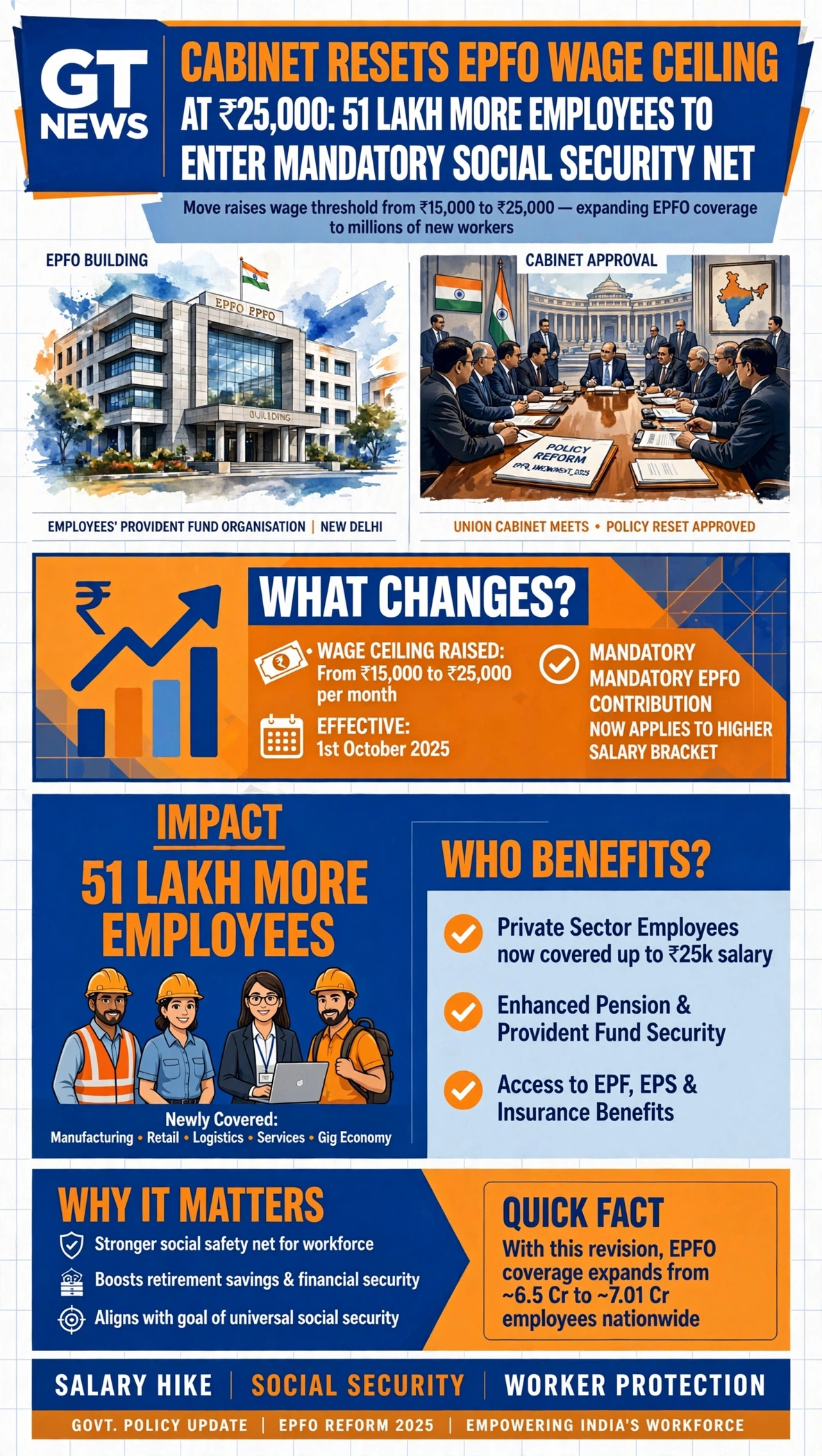
Twelve years after the previous revision, the Union Cabinet clears a major expansion of EPFO coverage; new ceiling takes effect from Vishwakarma Jayanti
GTNS , SEPTEMBER 16, 2026 , NEW DELHI: The salary threshold that determines mandatory coverage under India’s Employees’ Provident Fund Organization is set for a major reset, with the Union Cabinet approving an increase from ₹15,000 to ₹25,000 per month.
The decision, announced by Union Information and Broadcasting Minister Ashwini Vaishnaw after Wednesday’s Cabinet meeting, is expected to bring more than 51 lakh additional employees within mandatory EPFO coverage. The revised ceiling will come into effect from September 17, 2026 — Vishwakarma Jayanti.
The move changes a wage threshold that had remained at ₹15,000 since September 2014, extending the mandatory social-security framework to a wider section of India’s formal workforce.
A ₹10,000 change with a much wider reach
The Cabinet decision increases the EPFO wage ceiling by ₹10,000 a month, effectively bringing employees in the ₹15,000–₹25,000 wage range into mandatory coverage, subject to applicable EPF rules.
Until now, a newly joining employee earning above ₹15,000 a month was not automatically covered under the mandatory EPF framework merely on the basis of wages.
The revised ceiling changes that threshold and is expected to significantly enlarge the number of workers entering the statutory social-security system.
51 lakh additional employees in focus
According to the government, the immediate expansion could cover more than 51 lakh additional employees.
The Cabinet decision therefore affects a specific group of workers who had remained outside automatic mandatory coverage because their wages exceeded the previous ceiling.
For these employees, the change potentially opens access to three major components administered through the EPFO framework:
- Employees’ Provident Fund (EPF) — retirement-oriented provident fund savings.
- Employees’ Pension Scheme (EPS) — pension benefits subject to the applicable scheme provisions.
- Employees’ Deposit Linked Insurance Scheme (EDLI) — insurance protection linked to EPF membership.
Why 2014 became the dividing line
The previous EPFO wage ceiling revision took place in September 2014, when the limit was raised to ₹15,000.
Before that revision, the ceiling had remained unchanged during the 2004–2014 period.
The government has linked the latest revision to changes in the employment and wage environment, including sustained wage growth, higher incomes and the expansion of formal employment over the intervening years.
The latest move therefore brings the statutory threshold closer to the present wage environment after a 12-year gap.
₹11,339 crore annual government outgo
The expanded coverage will also have a fiscal implication.
The government’s estimated annual expenditure associated with the revised framework is approximately ₹11,339 crore. Existing annual budgetary support has been reported at around ₹10,250 crore, indicating an increase in government expenditure as coverage expands.
Over a five-year period, the estimated expenditure has been reported at approximately ₹56,696 crore.
What changes for employers
The decision is not limited to employee benefits.
As more employees become subject to mandatory EPFO coverage, eligible employers will have corresponding statutory contribution and compliance responsibilities under the applicable EPF framework.
The expanded coverage therefore affects payroll administration, employer contributions and employee social-security records alongside the worker’s own retirement-linked benefits.
Government statements have also connected wider social-security coverage with stronger employee retention and a more stable formal workforce.
EPFO’s existing scale
The change comes against the backdrop of an already large EPFO network.
Current figures cited in reporting place the organisation at approximately 7.98 crore contributing members, covering around 7.68 lakh contributing establishments.
The Employees’ Pension Scheme provides pension benefits to around 82 lakh pensioners, according to figures reported after the Cabinet announcement.
The new wage ceiling will add another layer to that existing social-security architecture.
From salary threshold to retirement protection
The practical significance of Wednesday’s decision will be seen at the workplace level.
For an employee earning between ₹15,000 and ₹25,000 who falls within the mandatory framework, EPFO participation can mean regular provident-fund savings along with access to pension and insurance-linked provisions under the applicable schemes.
The change also brings a larger section of formal-sector employees into a system designed to accumulate retirement savings over their working years.
The Vishwakarma Jayanti rollout
The government has chosen Vishwakarma Jayanti, September 17, as the effective date for the revised wage ceiling.
That means the Cabinet decision moves from announcement to implementation immediately after its approval, placing the new ₹25,000 threshold into the EPFO framework from Thursday.
THE NUMBERS AT A GLANCE
Old EPFO wage ceiling: ₹15,000/month
New EPFO wage ceiling: ₹25,000/month
Increase: ₹10,000/month
Additional employees expected to be covered: More than 51 lakh
Effective date: September 17, 2026
Annual estimated government expenditure: ₹11,339 crore
Estimated five-year expenditure: ₹56,696 crore
Previous ceiling revision: September 2014
EPFO contributing members: About 7.98 crore
Contributing establishments: About 7.68 lakh
EPS pensioners: About 82 lakh
A new boundary for India’s formal workforce
The Cabinet decision changes more than a number in the EPFO rulebook.
The move shifts the mandatory coverage boundary from ₹15,000 to ₹25,000, potentially bringing a sizeable group of salaried employees into the formal provident-fund, pension and insurance framework.
For workers, the impact will ultimately be reflected through their employment records, EPFO accounts and long-term social-security participation.
For employers, it creates a wider compliance responsibility.
And for the government, it represents an expansion of the financial and institutional footprint of India’s formal social-security system.
GLOBAL TIMES NEWS | INDIA