

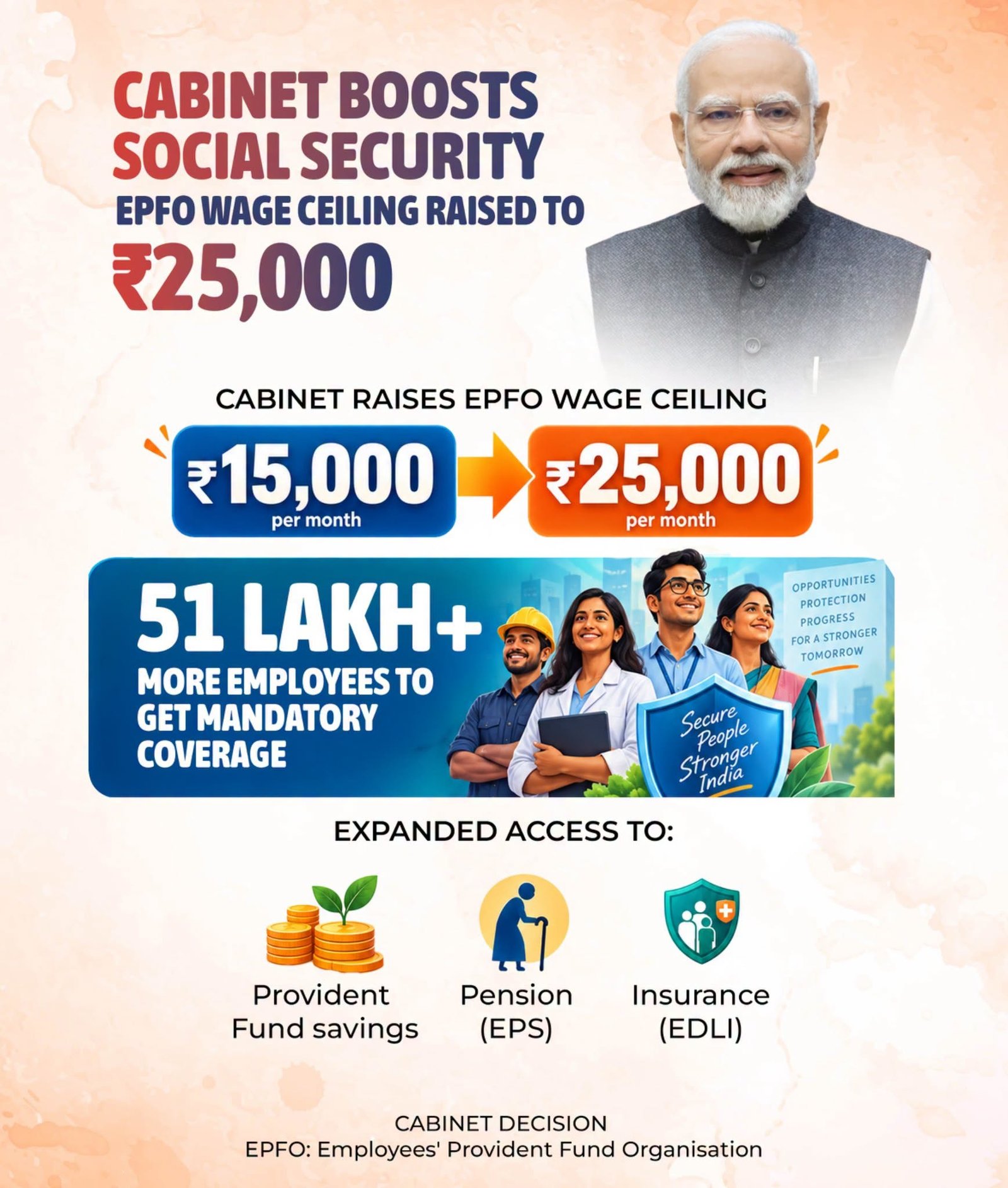
After 12 years at ₹15,000, the mandatory EPFO wage threshold is raised to ₹25,000; more than 51 lakh additional employees are expected to enter the coverage framework
GTNS , SEPTEMBER 16, 2026 , NEW DELHI: India’s formal workforce is set to see a major expansion of the wage boundary for mandatory provident-fund coverage after the Union Cabinet approved a sharp increase in the EPFO wage ceiling from ₹15,000 to ₹25,000 per month.
The decision was taken at a Cabinet meeting chaired by Prime Minister Narendra Modi and announced by Union Information and Broadcasting Minister Ashwini Vaishnaw during the post-Cabinet media briefing in New Delhi.
At the centre of the decision is a simple change in the salary threshold — but its potential reach is much wider. The government estimates that more than 51 lakh additional employees could come under mandatory EPFO coverage as a result of the revision.
THE ₹15,000 CEILING THAT STAYED FOR 12 YEARS
The previous mandatory EPFO wage ceiling of ₹15,000 was fixed in September 2014.
That threshold remained unchanged for the following 12 years. The latest Cabinet decision now raises it by ₹10,000, creating a new ceiling of ₹25,000 a month.
The change particularly affects the wage band between ₹15,000 and ₹25,000, subject to the applicable EPF provisions and eligibility conditions.
Government-linked reporting says the revision reflects changes in wages, incomes and the expansion of formal employment since the previous ceiling was established.
51 LAKH WORKERS AT THE CENTRE OF THE DECISION
The most significant number attached to the Cabinet decision is 51 lakh.
The government expects more than 51 lakh additional employees to enter mandatory EPFO coverage following the increase.
For workers who previously fell outside automatic mandatory coverage because their wages were above ₹15,000, the new ceiling creates a broader entry point into the statutory provident-fund system.
The precise benefits available to an individual employee will continue to depend on the applicable EPFO schemes, contribution rules and eligibility requirements.
WHAT EPFO COVERAGE MEANS
EPFO’s framework extends beyond a monthly provident-fund contribution.
It encompasses three major social-security components:
Employees’ Provident Fund (EPF): A retirement-oriented savings mechanism built through contributions from employees and employers under the applicable rules.
Employees’ Pension Scheme (EPS): Provides pension-related benefits subject to the scheme’s eligibility and pensionable-service provisions.
Employees’ Deposit Linked Insurance Scheme (EDLI): Provides insurance-linked protection to eligible EPF members under the applicable provisions.
The Cabinet decision expands the pool of employees who can enter this statutory framework through mandatory coverage.
THE CHANGE IS NOT ONLY ABOUT EMPLOYEES
The new ceiling also has consequences for covered establishments.
When employees fall within mandatory EPFO coverage, employers have corresponding responsibilities relating to registration, contributions, records and statutory compliance.
That means the Cabinet decision will be felt on both sides of the payroll — through expanded social-security participation for eligible employees and additional compliance responsibilities for covered employers.
₹11,339 CRORE ANNUAL GOVERNMENT OUTGO
The expansion also carries a financial commitment.
The government’s estimated annual expenditure associated with the decision is approximately ₹11,339 crore, according to figures released following the Cabinet announcement.
The expenditure reflects the larger scale of the social-security framework as additional employees are brought within mandatory EPFO coverage.
WHY THE TIMING MATTERS
The decision comes after a long period without an increase in the wage ceiling.
In 2014, the threshold was raised from ₹6,500 to ₹15,000.
Twelve years later, the government has now moved the ceiling to ₹25,000.
The result is a substantial widening of the wage range covered by the mandatory framework.
THE ₹25,000 THRESHOLD IN PRACTICAL TERMS
The change can be understood through three salary bands:
Below ₹15,000: Existing EPF rules and eligibility provisions continue to apply.
₹15,000–₹25,000: This is the principal new wage band brought into focus by the revised mandatory ceiling, subject to applicable provisions.
Above ₹25,000: The revised mandatory ceiling does not automatically mean every employee above ₹25,000 is outside EPFO; existing statutory rules and applicable membership provisions continue to determine coverage.
This distinction is important because the wage ceiling is a rule governing mandatory coverage, not a universal statement about who can or cannot have an EPFO account.
A LARGER SOCIAL-SECURITY FOOTPRINT
The Cabinet announcement comes as EPFO itself is undergoing broader changes.
Earlier this year, the government notified the Employees’ Provident Fund Scheme, 2026, which came into effect on June 29 as part of implementation of the Code on Social Security, 2020. The new framework retains the standard 12% employee and 12% employer contribution rates, subject to the applicable rules, while also emphasising digital compliance, online claims, e-passbooks and portability.
The wage-ceiling decision therefore comes alongside a broader transition in how provident-fund administration is being structured.
EMPLOYERS ALSO FACE A WIDER COMPLIANCE LANDSCAPE
For companies and establishments, the expansion of mandatory coverage arrives at a time when EPFO is simultaneously pushing greater compliance.
The Labour Ministry has launched initiatives such as VISHWAS, 2026, aimed at resolving long-pending disputes relating to EPF damages, and the Employees’ Enrolment Campaign, 2026, intended to help establishments bring previously uncovered eligible employees into the EPF system.
The combination means the EPFO ecosystem is moving on two fronts — widening coverage and strengthening compliance.
FROM ₹15,000 TO ₹25,000 — THE NUMBERS
| Parameter | Cabinet Decision |
|---|---|
| Previous wage ceiling | ₹15,000/month |
| New wage ceiling | ₹25,000/month |
| Increase | ₹10,000/month |
| Additional employees expected to be covered | More than 51 lakh |
| Estimated annual government outgo | ₹11,339 crore |
| Previous major revision | September 2014 |
| New decision | September 16, 2026 |
WHAT CHANGES NEXT
The Cabinet’s decision now shifts the issue from policy approval to implementation.
Employers covered by the EPF framework will need to apply the revised provisions to eligible employees, while workers entering mandatory coverage will see the consequences through their provident-fund and related social-security records.
For the government, the move expands the population within the formal social-security architecture and increases the associated public expenditure.
For employees in the newly affected wage range, the most visible change will be the transition from the old ₹15,000 boundary to the new ₹25,000 threshold.
THE BIGGER STORY
The Cabinet decision is therefore not simply an increase of ₹10,000 in an EPFO number.
It redraws the mandatory social-security boundary for a sizeable section of India’s formal workforce after a 12-year gap.
With more than 51 lakh additional employees expected to come within the expanded framework, the policy will now move from a Cabinet announcement in New Delhi to its practical impact across workplaces, payroll systems and EPFO accounts.
GLOBAL TIMES NEWS | INDIA