

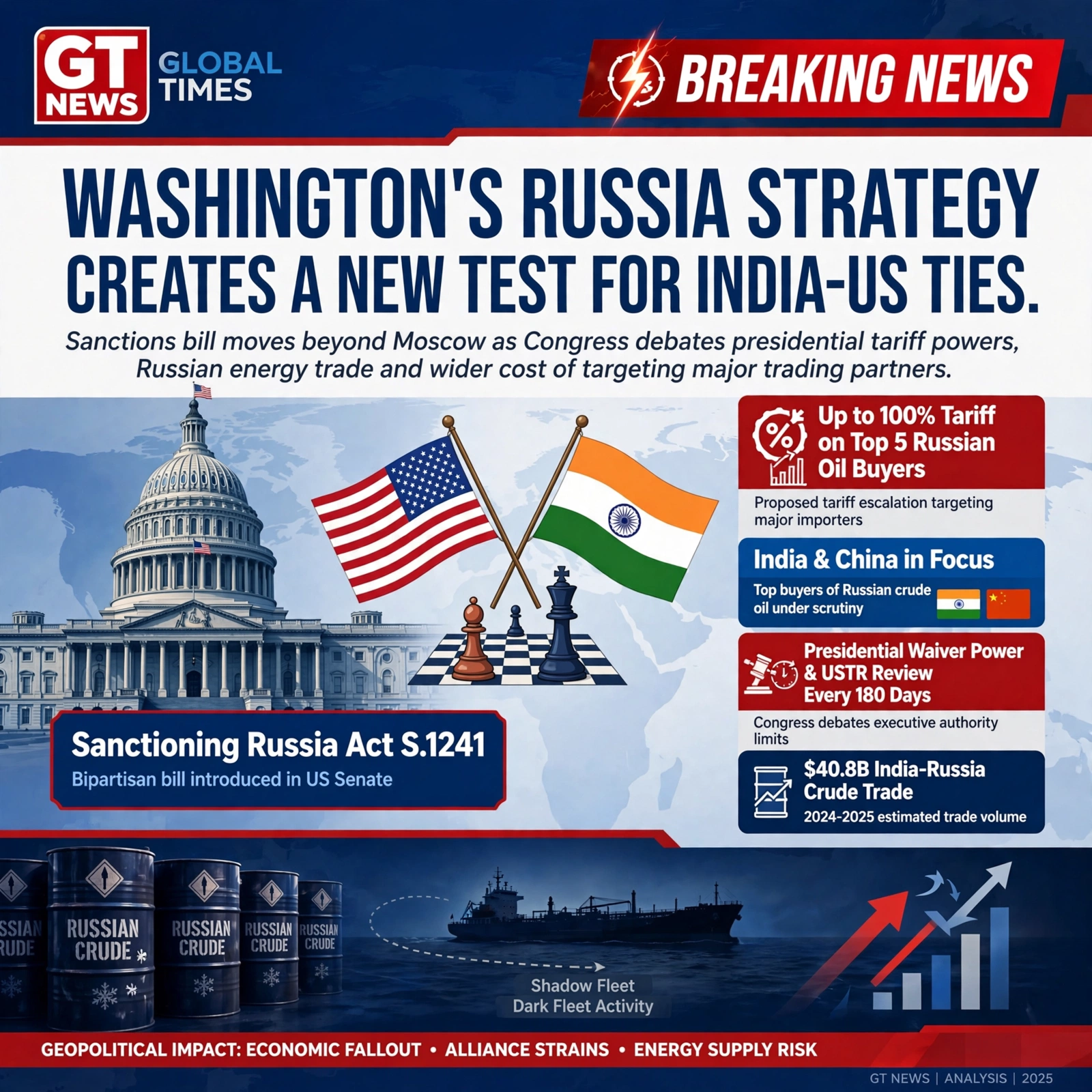
Sanctions bill moves beyond Moscow as Congress debates presidential tariff powers, Russian energy trade and the wider cost of targeting major trading partners
GTNS ,SEPTEMBER 16, 2026 , NEW DELHI: What began in Washington as an effort to tighten economic pressure on Russia has now opened a much wider debate—one involving presidential tariff powers, global energy trade and the economic choices of countries such as India.
The US House of Representatives has advanced the Lindsey O. Graham Sanctioning Russia and Iran Act of 2026, bringing the legislation closer to a final vote. The measure could give President Donald Trump authority to impose tariffs of up to 100 per cent on countries that continue purchasing Russian oil and gas.
India has been specifically identified among the countries that could potentially come within the tariff mechanism. But the legislation has not itself imposed a 100 per cent tariff on India.
THE REAL BATTLE IS LARGER THAN RUSSIAN OIL
The proposed legislation is designed to squeeze Russia’s economic capacity by targeting the revenue streams connected to its energy exports.
But its potential effect reaches far beyond Moscow.
If enacted and subsequently used, the tariff mechanism could affect goods exported by countries purchasing Russian energy. That makes the legislation simultaneously a sanctions instrument and a trade-policy tool.
India’s position has therefore become part of a much broader American debate over how economic pressure on Russia should be applied.
HOUSE VOTE REVEALS DIVISION OVER PRESIDENTIAL POWER
The legislation cleared a key procedural hurdle by 214 votes to 211.
Two Democrats joined Republicans in supporting the move, while the narrow margin highlighted disagreements inside the House over the scope of the proposed powers.
The Senate had already approved the legislation in August by 86-11, giving the bill a strong bipartisan foundation before it reached the House.
The central question in Washington is therefore not simply whether Russia should face tougher sanctions.
It is also how much authority the President should have to impose tariffs on countries dealing with Russia.
INDIA’S NAME CHANGES THE EQUATION
India’s inclusion gives the legislation a direct connection to one of America’s major trading partners.
A House amendment specifically identified India, China, Türkiye, Azerbaijan, Hungary, Slovakia, the UAE, Singapore, Kazakhstan and Kyrgyzstan as countries that could potentially be subjected to the secondary tariff mechanism.
That language moves the discussion from a general Russia sanctions framework to a measure with possible consequences for individual national economies.
RUSSIA’S ENERGY NETWORK UNDER PRESSURE
The proposed sanctions package targets several parts of Russia’s economic structure.
It includes measures concerning Russia’s leadership, energy sector, financial institutions and defence-related interests.
The legislation also targets vessels associated with sanctions evasion, including the network commonly described as Russia’s “shadow fleet” of tankers.
The objective is to make it more difficult for Russian energy revenues to move through channels designed to avoid existing restrictions.
IRAN IS PART OF THE SAME PACKAGE
The legislation also contains provisions relating to Iran, making the measure wider than the Russia-India energy question.
The Iran-related provisions would extend the sanctions framework covering Iran’s energy sector, adding another major foreign-policy component to the bill.
WHY INDIA MATTERS
India’s position is important because Russian crude has become a significant component of its energy-import basket.
Recent reporting has described India as one of the largest buyers of Russian crude, meaning any US policy linking Russian energy purchases with trade penalties could have consequences beyond diplomacy.
The potential impact would be felt principally through the US market for Indian exports, rather than through a direct American tax on Russian oil purchased by India.
A TRADE QUESTION DISGUISED AS A SANCTIONS QUESTION
This is where the legislation acquires a wider significance.
Traditional sanctions generally seek to restrict transactions with a targeted country or entity.
The proposed secondary-tariff mechanism operates differently: it could use access to the US market as leverage over third countries.
That creates a different policy equation for governments such as India’s.
The question becomes not only how much Russian energy a country purchases, but also how that purchasing decision interacts with its access to American markets.
THE INDIA-US RELATIONSHIP FACES ANOTHER POLICY VARIABLE
India and the United States have built a broad relationship covering trade, technology, defence, energy and strategic cooperation.
The Russia sanctions legislation introduces another variable into that relationship.
The issue is particularly sensitive because India’s energy policy and Washington’s Russia policy are based on different priorities.
For India, energy procurement is connected to supply, price and national economic requirements.
For Washington, Russian energy revenue is part of the wider sanctions strategy against Moscow.
The proposed legislation brings those two calculations into the same policy space.
100% IS A POSSIBLE CEILING, NOT AN ACTIVE DUTY
The figure attracting the most attention is 100 per cent.
However, the current legislative stage needs to be clearly understood.
The House has advanced the bill, but the final House vote and remaining legislative steps still matter. Even if the bill becomes law, the proposed provision would provide authority to the President; it would not automatically mean that every Indian product would immediately face a 100 per cent tariff.
Implementation would depend on subsequent executive action and the specific terms applied.
THE NEXT DECISION IS IN WASHINGTON
The immediate next stage is the House’s final consideration of the legislation.
If approved, it would proceed through the remaining congressional process before reaching the President.
That means the current development is best understood as a new potential pressure mechanism, rather than an already operational trade barrier against India.
A NEW KIND OF INDIA-US-RUSSIA EQUATION
The significance of the House action lies in the way it connects three separate interests:
Russia’s energy revenue.
India’s energy-security calculations.
India’s access to the US export market.
That connection could become increasingly important if the legislation becomes law and the tariff authority is used.
For now, the House action has opened the door to that possibility—but the final outcome will depend on the remaining legislative process and subsequent decisions in Washington.
GLOBAL TIMES NEWS | INDIA