
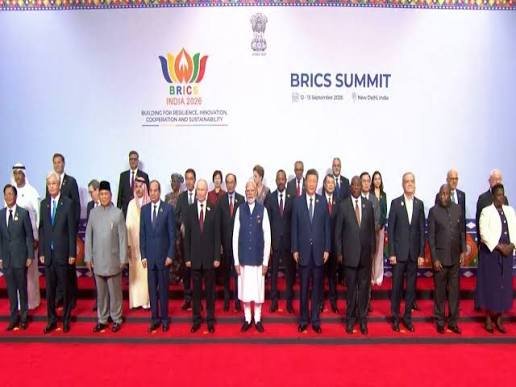
At Bharat Mandapam, the Prime Minister puts focus on cooperation, implementation and a stronger voice for emerging economies
NEW DELHI, GTNS, SEPTEMBER 13: Prime Minister Narendra Modi addressed the concluding session of the 18th BRICS Summit in New Delhi, placing India’s message at the Centre of discussions on the future direction of the grouping and its role in a rapidly changing global order.
Speaking at Bharat Mandapam, Modi used the closing session to underline the importance of cooperation among BRICS countries at a time when economies across the world are facing geopolitical uncertainty, supply-chain disruptions and growing pressure over access to technology and strategic resources.
The Indian approach during the summit has been centred on making BRICS more action-oriented, with greater emphasis on initiatives that can translate diplomatic discussions into practical outcomes.
India Pushes for a More Effective BRICS
The Prime Minister’s closing intervention comes as BRICS continues to expand its geographical and economic reach.
For India, the growing membership also brings a larger responsibility to maintain dialogue among countries with different political systems, economic priorities and national interests.
New Delhi has maintained that differences among members should not prevent cooperation in areas where common interests exist.
The emphasis has therefore been on consensus, mutual respect and practical collaboration rather than allowing disagreements to dominate the grouping’s agenda.
Global South at the Centre of India’s Message
Another important element of India’s BRICS presidency has been the effort to strengthen the voice of developing and emerging economies.
India has presented BRICS as a platform where countries of the Global South can discuss issues that directly affect their economic and developmental priorities.
These include access to finance, technology, energy, food security, healthcare, resilient supply chains and greater participation in international decision-making.
The New Delhi summit provided an opportunity for India to underline its position that emerging economies should have a meaningful role in shaping the rules governing the global economy.
From Declarations to Real-World Results
A key challenge before BRICS is ensuring that decisions taken at summits result in measurable action.
India’s message has increasingly focused on implementation rather than simply producing new declarations.
Areas such as digital cooperation, health security, logistics, innovation, start-ups, climate resilience and energy have emerged as potential fields where BRICS members can develop practical partnerships.
For businesses and citizens, the effectiveness of the grouping will ultimately be judged by whether these initiatives lead to greater economic opportunities, stronger connectivity and improved resilience.
Technology and Strategic Resources
The changing global economy has also increased the importance of technology and critical resources.
India has highlighted the need for responsible technological cooperation and stable access to strategic minerals and other resources required for modern industries.
The concern is that restrictions or disruptions involving technology and critical resources could create new vulnerabilities for developing economies.
Greater cooperation among BRICS members could potentially help build more reliable supply chains and reduce exposure to sudden external disruptions.
A Wider Role for BRICS
The 2026 summit comes at a time when BRICS has become a broader grouping than its original five-member format.
The expansion has increased the bloc’s economic and political weight but has also created a more complex environment for consensus-building.
India’s challenge during its chairship has been to bring diverse members together around areas of shared interest while maintaining the group’s focus on development and cooperation.
The concluding session therefore carries significance beyond the formal end of the summit. It also sets the tone for how BRICS could approach its next phase.
India’s Message: Cooperation Without Confrontation
New Delhi’s broader diplomatic message has been that cooperation among BRICS countries does not have to be directed against any other country or group.
Instead, India has advocated using the platform to promote dialogue, economic development and a more balanced international system.
The approach reflects India’s longstanding emphasis on strategic autonomy and its effort to maintain constructive relations with different global partners.
The Road Ahead
As the 18th BRICS Summit concludes in New Delhi, attention now shifts from the statements delivered at Bharat Mandapam to their implementation.
For India, the success of its BRICS presidency will ultimately be measured not simply by the number of meetings held or declarations adopted, but by whether cooperation produces tangible results.
Prime Minister Modi’s closing message has placed the focus on that next step—building a BRICS that is more responsive, more practical and more capable of addressing the economic and developmental concerns of its members and the wider Global South.
GTNS | NEW DELHI