

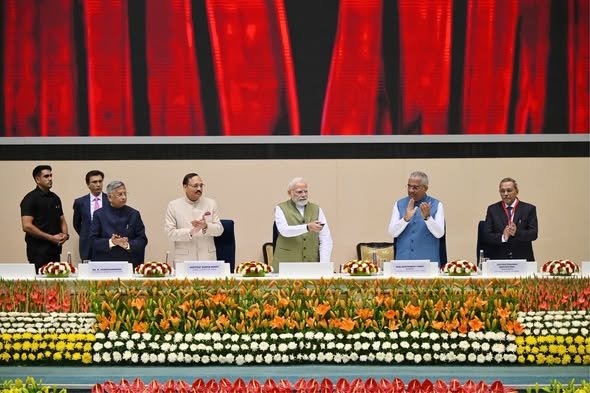
NGT conference brings judges, scientists, policymakers and environmental experts from India and 17 countries together to discuss climate justice, environmental law and sustainable development
Global Times News | INDIA ; GTNS
SEPTEMBER 19, 2026 , NEW DELHI — Prime Minister Narendra Modi on Saturday inaugurated a two-day international conference on “The Future of Environment and Climate Dynamics” at Vigyan Bhawan, New Delhi, bringing together judicial, scientific and policy voices from India and abroad to examine the environmental challenges shaping the coming decades.
The conference, organised by the National Green Tribunal (NGT) on September 19 and 20, is designed as a platform for exchanging judicial approaches, scientific knowledge and institutional experience on climate change, environmental governance and sustainable development. Participants include judges and judicial representatives from 17 countries, along with Indian judges, government officials, environmental authorities, academics and other specialists.
ENVIRONMENT, DEVELOPMENT AND JUSTICE AT THE CENTRE
The conference is addressing the increasingly connected questions of environmental protection, climate resilience, development and justice.
Four technical sessions have been planned around subjects including climate justice and inclusion, environmental law and governance, planetary environmental challenges and international cooperation, and future strategies for forest protection and restoration.
The discussions are intended to examine not only environmental policy, but also gaps in implementation and enforcement and the role of institutions in responding to climate-related challenges.
MODI LINKS CLIMATE ACTION WITH INDIA’S DEVELOPMENT PATH
Addressing the inaugural session, Prime Minister Modi highlighted India’s long-standing cultural relationship with nature and connected that tradition with contemporary environmental action.
He argued that economic development and environmental sustainability need not be treated as competing objectives. The Prime Minister also highlighted India’s renewable-energy expansion and said India had achieved commitments made under the Paris Agreement at COP21 ahead of the scheduled timeline. These statements were part of the Prime Minister’s address and represent the government’s assessment of India’s climate progress.
Modi also pointed to India’s international initiatives in areas such as solar energy, disaster-resilient infrastructure, biofuels and biodiversity as examples of India’s approach to international climate cooperation.
CARBON RESPONSIBILITY AND THE GLOBAL SOUTH
A significant part of the Prime Minister’s address focused on the distribution of responsibility for greenhouse-gas emissions.
Modi said developing countries have often faced disproportionate responsibility in global discussions on carbon emissions and pointed to India’s per-capita emissions as being below the global average.
His argument placed climate policy within the wider debate over equity between developed and developing countries, a longstanding issue in international climate negotiations.
CHIEF JUSTICE HIGHLIGHTS ENVIRONMENTAL JURISPRUDENCE
The inaugural session also featured Chief Justice of India Justice Surya Kant, who highlighted India’s evolving environmental jurisprudence.
According to the PIB account of his remarks, the Chief Justice referred to principles including the precautionary principle, polluter pays principle, absolute liability and public trust doctrine. He also noted the increasing constitutional relevance of climate-related issues involving equality, livelihood and health.
His intervention brought the judicial dimension of climate governance into the conference, alongside the scientific and policy discussions.
BHUPENDER YADAV HIGHLIGHTS INDIA’S CLIMATE INDICATORS
Union Environment, Forest and Climate Change Minister Bhupender Yadav highlighted India’s progress in renewable energy and environmental conservation.
According to the Ministry’s account, non-fossil sources represented 54.18 per cent of installed electricity capacity, which the government says places India ahead of its 2030 target of 50 per cent. The minister also highlighted India’s position in renewable-energy capacity and its conservation programmes for wildlife and ecosystems.
He emphasised that the central challenge is not necessarily a choice between development and environmental protection, but achieving development that can remain sustainable over time.
NGT MOBILE APPLICATION LAUNCHED
During the inaugural session, Prime Minister Modi also launched the National Green Tribunal Mobile Application.
The application adds a digital component to the functioning of the environmental adjudication system and was unveiled alongside discussions on strengthening environmental governance and institutional cooperation.
INTERNATIONAL PARTICIPATION
The conference has brought together participants from countries across different regions, along with representatives of international organisations including the United Nations Environment Programme (UNEP) and the Asian Development Bank (ADB).
The NGT says the objective is to facilitate knowledge exchange and develop practical recommendations and a roadmap for cooperation on environmental and climate challenges that cross national boundaries.
FROM DISCUSSION TO IMPLEMENTATION
The central challenge emerging from the conference is not simply the recognition of climate risks, but the ability of governments, courts, scientific institutions and international organisations to translate environmental commitments into enforceable and measurable action.
With climate change increasingly affecting ecosystems, cities, water resources, energy systems and livelihoods, the conference is seeking to connect environmental law and scientific evidence with policy implementation.
The two-day meeting in New Delhi therefore places climate justice, environmental governance, sustainable development and international cooperation within one common discussion, with the final emphasis expected to be on practical cooperation and future action.
Global Times News | INDIA ; GTNS NEWS DESK