

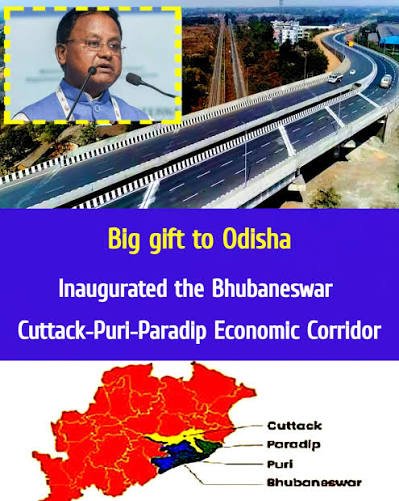
September 06/26/(GTNS ) Bhubaneswar: Odisha’s long-term development strategy is increasingly focusing on creating stronger economic links between its major urban, coastal and industrial centres. As part of this broader vision, the proposed Bhubaneswar–Cuttack–Puri–Paradip economic region is being examined from the perspective of infrastructure, investment, connectivity, employment and balanced regional growth.
The four-city economic belt brings together some of Odisha’s most important economic assets. Bhubaneswar serves as the state’s administrative and emerging services hub, Cuttack has a strong commercial and industrial identity, Puri remains a major tourism and cultural destination, while Paradip is a key gateway for maritime trade and industrial activity.
The implementation review is significant because the success of such a regional development model will depend not only on individual projects but also on how effectively the four centres are connected and integrated.
Focus on integrated growth
The emerging approach seeks to move beyond city-specific development. Instead, planners are looking at the region as an interconnected economic system in which transport networks, industrial areas, logistics facilities, tourism destinations and urban infrastructure can support one another.
Better road and rail connectivity could reduce travel and transportation barriers between the four centres. At the same time, improved logistics infrastructure around Paradip could strengthen the movement of industrial goods, while better connectivity with Bhubaneswar and Cuttack could support business and service-sector expansion.
Puri brings a different economic dimension through tourism, hospitality, cultural activities and related services. A stronger regional transport network could potentially allow visitors to combine destinations within a single travel circuit, creating opportunities for businesses beyond the traditional tourism zones.
Infrastructure at the centre of the plan
Infrastructure is expected to remain one of the most important pillars of the proposed economic region.
Urban expansion around Bhubaneswar and Cuttack has created growing demand for roads, public transport, housing, water supply, waste management and other civic facilities. A coordinated regional approach could help address these challenges while preparing the area for future population and investment growth.
Connectivity with Paradip will also have strategic importance. Efficient freight movement between industrial centres, logistics hubs and the port can influence the competitiveness of Odisha’s manufacturing and export sectors.
Similarly, smoother connections to Puri could support tourism while reducing pressure on individual urban centres.
Investment and employment opportunities
One of the major expectations from the economic region is the creation of new investment opportunities.
A coordinated development framework could encourage businesses to consider the wider region rather than concentrating investment in a single city. Manufacturing, logistics, information technology, tourism, food processing, retail, construction and service industries could all benefit from improved regional infrastructure.
Employment generation will be another key measure of the initiative’s success. For Odisha’s young workforce, the expansion of industries and services across the region could create opportunities closer to home and encourage the development of new business ecosystems.
However, experts and stakeholders will also need to examine whether investment reaches smaller towns and communities surrounding the four major centres. Inclusive growth will be crucial if the economic region is to become a long-term development model.
Paradip’s strategic role
Paradip is likely to occupy a particularly important position in the regional economic framework because of its maritime and industrial significance.
A stronger connection between the port economy and inland industrial centres could improve supply chains and reduce logistical delays. Warehousing, transportation, processing industries and export-oriented businesses could gain from a more integrated network.
The wider objective would be to transform connectivity into economic value by ensuring that port-linked development generates opportunities across the region rather than remaining concentrated around the port itself.
Tourism as a growth engine
Puri offers the economic region a strong tourism component. Its religious, cultural and coastal attractions already draw visitors from across India and abroad.
The challenge will be to build a tourism ecosystem that benefits local communities while maintaining the cultural and environmental character of the destination.
An integrated Bhubaneswar–Cuttack–Puri tourism circuit could encourage longer visitor stays and create opportunities for hotels, restaurants, transport operators, handicraft businesses, tour services and local entrepreneurs.
Bhubaneswar’s heritage sites and Cuttack’s cultural identity could complement Puri’s religious tourism, giving visitors a wider experience within a connected regional circuit.
Urban growth needs careful planning
Rapid economic expansion can also create pressure on land, transport systems and natural resources.
The four-city region will therefore require careful urban planning. Uncontrolled expansion could lead to congestion, environmental stress and rising infrastructure costs.
Future planning may need to consider public transportation, integrated land-use planning, green spaces, drainage systems, affordable housing and climate resilience.
The region’s coastal location also makes environmental preparedness particularly important. Development projects will need to balance economic ambitions with protection of water bodies, coastal ecosystems and other sensitive areas.
Vision 2047 and the bigger picture
The proposed economic region fits into a much larger development ambition for Odisha by 2047. The objective is not simply to expand existing cities but to create an economic network capable of supporting sustained growth over several decades.
For this to happen, implementation will be more important than announcements. Projects will need clear timelines, coordinated execution, reliable funding and measurable outcomes.
Regular monitoring can help identify delays, resolve coordination problems and ensure that infrastructure projects deliver their intended economic benefits.
A test of coordinated governance
The Bhubaneswar–Cuttack–Puri–Paradip region also presents an opportunity to strengthen coordination among different government departments and local authorities.
Transport, housing, industries, tourism, urban development, ports and environmental planning often operate through separate administrative structures. A regional economic strategy will require these sectors to work towards common objectives.
The effectiveness of this coordination could ultimately determine whether the four-city region develops into a genuinely integrated economic zone.
The road ahead
Odisha’s economic transformation will depend on how effectively its infrastructure, natural advantages and human resources are brought together.
The review of the Bhubaneswar–Cuttack–Puri–Paradip economic region therefore represents more than an assessment of individual projects. It is an opportunity to examine whether the state can build a connected economic corridor capable of supporting industry, tourism, trade, urban development and employment simultaneously.
As Odisha looks towards 2047, the four-city region could emerge as one of the most important development corridors in the state. But its success will ultimately depend on execution, coordination and the ability to ensure that economic growth reaches communities across the wider region.
For Odisha, the message is clear: Vision 2047 will be judged not only by the scale of its plans, but by the quality and speed of their implementation.