

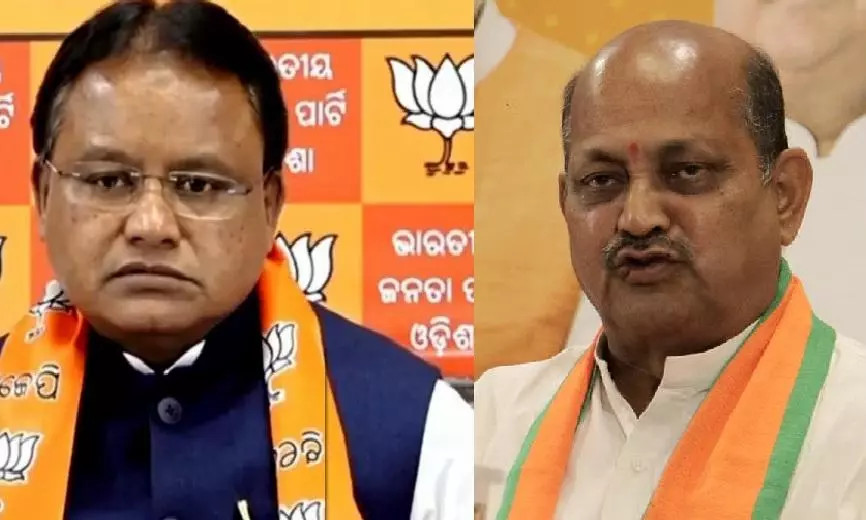
With the next rural and urban local-body elections approaching, both major political parties are turning their attention to booth-level organization, public outreach and ground-level political networks
SEPTEMBER 13, 2026 , BHUBANESWAR, GTNS: Odisha’s political contest is gradually moving beyond the Assembly floor and towards the grassroots, with the Bharatiya Janata Party (BJP) intensifying its organisational preparations and the Biju Janata Dal (BJD) also stepping up efforts to strengthen its political network ahead of the next round of local elections.
The shift is significant because local elections in Odisha are fought largely through village-level workers, booth networks, local leaders and direct voter contact. The parties are therefore beginning to treat the coming electoral cycle as an important test of their organisational strength.
Recent BJP organisational meetings have focused on preparations for the forthcoming panchayat and urban local-body elections. The party has also been reviewing its booth-level structure and wider grassroots preparedness.
BJP LOOKS BEYOND GOVERNMENT TO ORGANISATIONAL STRENGTH
For the BJP, the challenge is no longer simply winning power in the state. After forming the government in Odisha, the party now faces the task of converting its electoral breakthrough into a durable grassroots organisation.
The BJP’s recent organisational activities indicate an emphasis on reaching voters at the local level and maintaining an election-ready structure. Its planned Seva Sankalp Abhiyan, beginning September 17, is another major public-outreach exercise involving party workers and community-oriented programmes.
The political calculation is straightforward: a strong government presence can provide visibility, but local elections depend heavily on the strength of workers and leaders in villages, wards and booths.
BJD’S NEXT TEST: RETAINING ITS GRASSROOTS NETWORK
The BJD, meanwhile, is facing a different political challenge.
After losing government in 2024, the regional party must demonstrate that its long-standing organisational network remains effective outside the Assembly. Party president and former Chief Minister Naveen Patnaik has continued to hold organisational discussions and focus on grassroots political activity ahead of future elections.
For the BJD, the upcoming local elections could therefore become an important opportunity to measure its organisational strength after its transition from ruling party to opposition.
Rather than simply relying on its previous electoral record, the party will have to reconnect with local workers, candidates and voters and build an effective campaign at the grassroots.
PANCHAYAT POLLS COULD BE THE FIRST BIG INDICATOR
The expected 2027 panchayat elections are likely to provide the first major statewide test of this new political equation. Current reports indicate that the polls are expected around March-April 2027, although the final schedule will be announced by the State Election Commission.
The result will be watched closely because panchayat politics reaches directly into villages and local communities.
A strong performance by the BJP could strengthen the argument that the party’s 2024 Assembly victory has translated into a wider grassroots base. A strong BJD showing, on the other hand, could demonstrate that the regional party continues to possess substantial organisational strength despite being out of power.
LOCAL LEADERS MAY DECIDE THE NEXT POLITICAL CHAPTER
The coming contest is unlikely to be decided only by major state-level speeches.
Local candidates, panchayat leaders, booth workers, ward-level organisers and community networks could play a decisive role. Issues such as roads, drinking water, welfare delivery, employment, agriculture, local infrastructure and development may become more important to voters than broad political narratives.
This makes grassroots organisation a crucial political asset for both parties.
CONGRESS ALSO REMAINS A FACTOR
Although the main political battle is increasingly being viewed through the BJP-BJD contest, Congress cannot be completely ignored.
The performance of Congress candidates in selected constituencies could influence three-cornered contests and alter the final outcome in closely fought local seats.
Therefore, the 2027 local elections may provide a more detailed picture of Odisha’s emerging political landscape than state-level political statements alone.
THE BIG POLITICAL QUESTION
The central question now is whether Odisha’s 2024 political change will develop into a long-term realignment or whether the BJD can successfully rebuild its grassroots electoral strength.
The BJP is attempting to consolidate its position through organisation and public outreach. The BJD is seeking to remain politically relevant and strengthen its opposition machinery.
The answer will not come from party meetings alone.
It will ultimately be decided at the panchayat, ward, booth and village level—where Odisha’s next political battle is already beginning to take shape.
GTNS | BHUBANESWAR