

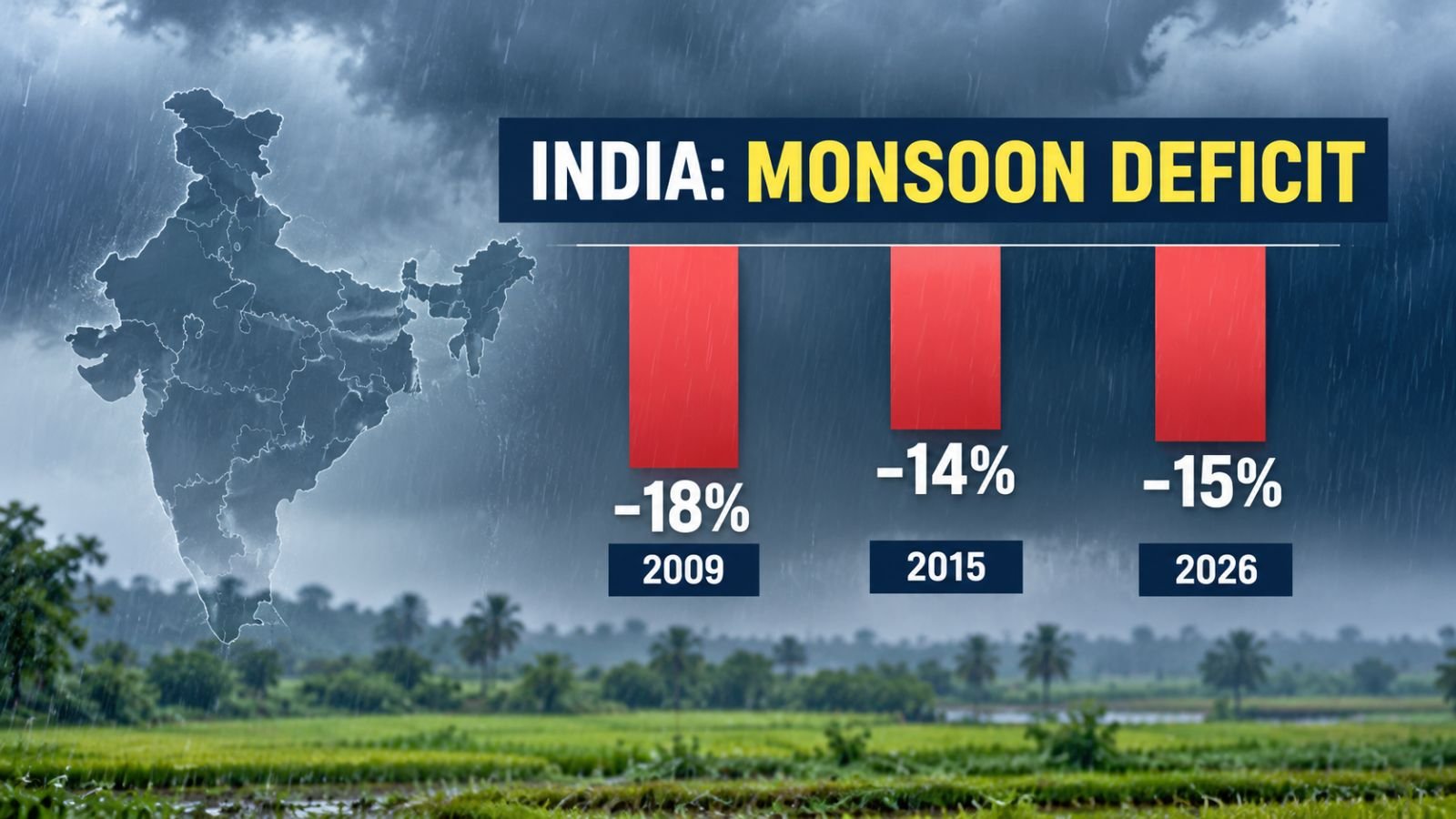
IMD records 759.4 mm rainfall during June–September; regional imbalance leaves large parts of eastern, northeastern and southern India under pressure
GTNS | NEW DELHI | OCTOBER 1, 2026 , India’s four-month southwest monsoon season has ended with a substantial rainfall deficit, bringing the country’s water and agricultural situation into focus as the post-monsoon period begins.
According to the final assessment released by the India Meteorological Department (IMD), India received 759.4 mm of rainfall between June and September, against a long-period average of 868.6 mm. The season produced only 87% of the LPA, making it the fourth-lowest monsoon rainfall total since 2001 and the 13th-lowest since 1901.
Rainfall was not uniform across India
The national figure hides substantial differences between regions.
IMD data show that Northwest India received 94% of its LPA, while Central India received 97%, keeping both regions within the normal rainfall range.
The situation was markedly different in the East and Northeast, where rainfall was only 74% of LPA. South Peninsular India received 76% of its normal rainfall.
The East and Northeast region recorded 1,016.3 mm, while South Peninsular India received 542 mm during the season.
IMD described the rainfall over East and Northeast India as the lowest for that region since 1901, while rainfall over South Peninsula was the fourth-lowest since 1901 and the second-lowest since 2001.
Odisha stands out in the national rainfall map
Odisha recorded a different pattern from many other parts of the country.
Among India’s 36 meteorological subdivisions, Odisha was the only subdivision to record excess seasonal rainfall, according to the IMD’s final monsoon report.
Eighteen subdivisions, covering 53% of the country’s area, recorded normal rainfall, while 17 subdivisions covering 42% of the area remained deficient.
This regional variation means that the national deficit cannot be treated as a uniform shortage across every state.
A season of sharp swings
The 2026 monsoon did not follow a steady rainfall pattern.
June was particularly weak, with the country receiving only 65% of its normal rainfall. July brought a significant recovery and reached 101% of LPA.
The improvement did not continue. August slipped to 84%, while September ended at 92% of LPA.
Weekly rainfall figures also showed extreme fluctuations. A week ending July 8 recorded a 45.4% surplus, but the following week saw a 51.1% deficit.
By the week ending September 9, the seasonal rainfall departure had fallen to around 36.3% below normal before a late-September wet spell brought some improvement.
Agriculture enters the next phase with uneven moisture conditions
The monsoon is critical for India’s rain-fed agricultural areas.
The IMD’s monsoon-core zone, which includes many rain-fed farming regions, received 779.9 mm, below the lower threshold of its normal rainfall category.
The implications will differ from state to state because rainfall distribution, irrigation availability, reservoir levels and crop patterns are not uniform.
For farmers preparing for the rabi season, soil moisture and water availability will therefore remain important factors.
Water storage becomes a key concern
The rainfall shortfall also puts greater attention on reservoirs and other water resources.
The Central Water Commission’s assessment reported that storage in 178 major reservoirs stood at around 70% of total capacity as of September 28, below both the decadal average and the corresponding level of the previous year. South India faced particularly low storage levels.
This makes water management increasingly important in regions where rainfall was substantially below normal.
El Niño remains an important climate factor
The weak monsoon developed alongside an El Niño pattern.
IMD’s assessment indicates that the monsoon’s behaviour was characterised by repeated wet and dry spells rather than a consistent rainfall regime. The department also recorded 77 low-pressure-system days, compared with a climatological average of 57.
IMD’s post-monsoon outlook will now become important for southern and southeastern parts of India, where the northeast monsoon can contribute significantly to seasonal rainfall.
The economic impact may extend beyond farming
The effects of a deficient monsoon are not restricted to agriculture.
Lower farm output or reduced farm incomes can affect rural purchasing power, demand for agricultural equipment and consumption in villages.
Reuters reported on October 1 that India’s weak monsoon was already being reflected in September rural vehicle and tractor sales, with several manufacturers reporting declines in rural-linked segments.
At the same time, the impact will not necessarily be uniform because urban consumption, government support, irrigation and foodgrain stocks can partly offset regional agricultural weakness.
What comes next
The end of the southwest monsoon does not mean the end of India’s rainfall season.
The focus now shifts toward the post-monsoon period and, particularly for southern India, the northeast monsoon.
For policymakers, the immediate issues include reservoir management, groundwater conservation, agricultural planning and monitoring of food prices.
The 2026 monsoon has therefore left India with a complicated rainfall picture: a national deficit, major regional differences and one state subdivision—Odisha—recording excess rainfall.
The next challenge will be converting available water resources into adequate support for agriculture, drinking-water needs and the coming rabi season.