
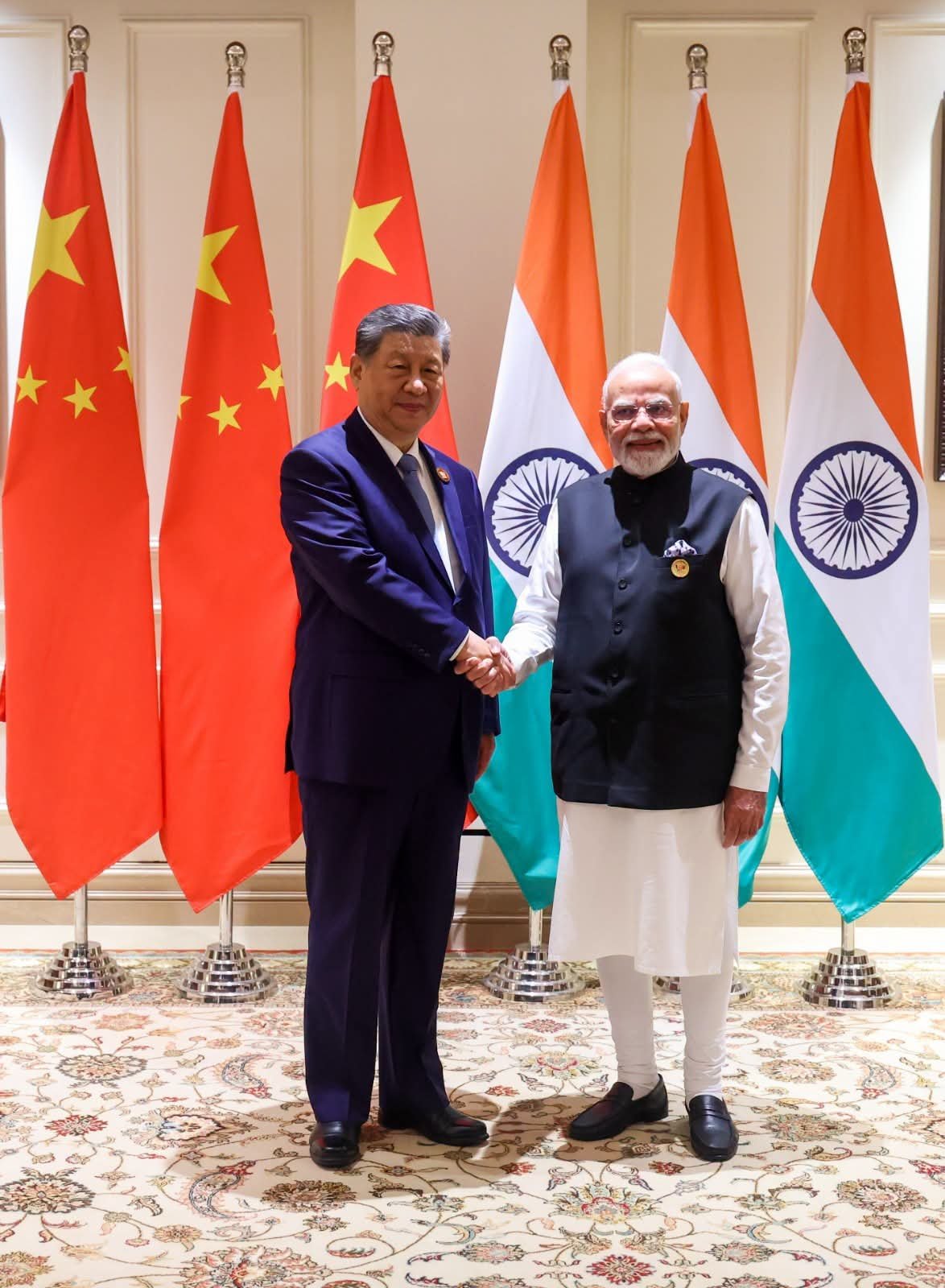
Prime Minister Narendra Modi and Chinese President Xi Jinping hold key bilateral talks on the sidelines of the BRICS Summit in New Delhi, focusing on border peace, long-term relations, mutual interests and expanding cooperation between the two Asian powers.
NEW DELHI: Prime Minister Narendra Modi and Chinese President Xi Jinping held a significant bilateral meeting on the sidelines of the 18th BRICS Summit in New Delhi on Saturday, signalling a cautious but potentially important new phase in India-China relations.
The meeting, which lasted more than 50 minutes, came during Xi Jinping’s first visit to India in seven years and against the backdrop of efforts by both countries to stabilise ties following years of military and diplomatic tensions.
Strategic and long-term approach
A key message emerging from the meeting was the need to view India-China relations from a strategic and long-term perspective. Both leaders welcomed progress made since their previous meeting in Tianjin in August 2025 and underlined the importance of maintaining stability in bilateral relations.
The discussions also focused on preventing differences between the two Asian powers from becoming wider disputes. The two sides reaffirmed their commitment to seeking a fair, reasonable and mutually acceptable settlement of the boundary question.
Border peace remains central
The border issue continues to be one of the most sensitive areas in the relationship. The deadly Galwan Valley confrontation in 2020 sharply damaged bilateral ties and led to military deployments, diplomatic restrictions and a decline in people-to-people exchanges.
Although disengagement arrangements subsequently helped reduce tensions, substantial military deployments remain along the disputed Himalayan frontier. The latest Modi-Xi engagement therefore carries significance beyond diplomatic symbolism, with border stability remaining a major test for any sustained improvement in relations.
Trade, business and people-to-people ties
The two leaders also discussed ways to expand economic and societal connections. Issues included trade imbalances, supply-chain concerns, predictable market access, business links, cultural exchanges and greater mobility between the two countries.
China remains a major source of imports for India, making economic engagement an important component of the relationship even as New Delhi continues to exercise caution over Chinese investment in strategically sensitive sectors.
BRICS provides wider diplomatic space
The meeting also demonstrated how the BRICS platform can provide space for dialogue between countries that have unresolved bilateral differences.
India, as the 2026 BRICS chair, has repeatedly emphasised cooperation, consensus and strategic autonomy. Modi has also stressed that BRICS is not intended to be directed against any particular country.
For China, stronger India-China engagement can contribute to its wider vision of cooperation among major Global South economies. Xi has called for India and China to draw on their respective strengths, support one another and work for global peace and stability.
A thaw, but not a full reset
The Modi-Xi meeting should therefore be viewed as a cautious diplomatic thaw rather than a complete reset.
The two governments have made progress in restoring direct flights, improving business-visa processes and rebuilding exchanges, while bilateral trade has also recovered. But unresolved border questions, strategic competition, trade concerns and differing approaches to regional security continue to place limits on the relationship.
The significance of the New Delhi meeting lies in its message: India and China appear willing to manage their differences while searching for areas of practical cooperation.
The challenge now will be to translate the diplomatic understanding between Modi and Xi into sustained progress on the border, trade, investment, connectivity and people-to-people relations.
For India, the emerging approach reflects a familiar balance—engage China where interests converge, protect national interests where they diverge, and keep strategic autonomy at the centre of foreign policy.
Global Times News | INDIA ; GTNS
SEPTEMBER 12, 2026