
India uses its BRICS presidency to push for stronger multilateral institutions, a more representative United Nations and greater voice for developing countries
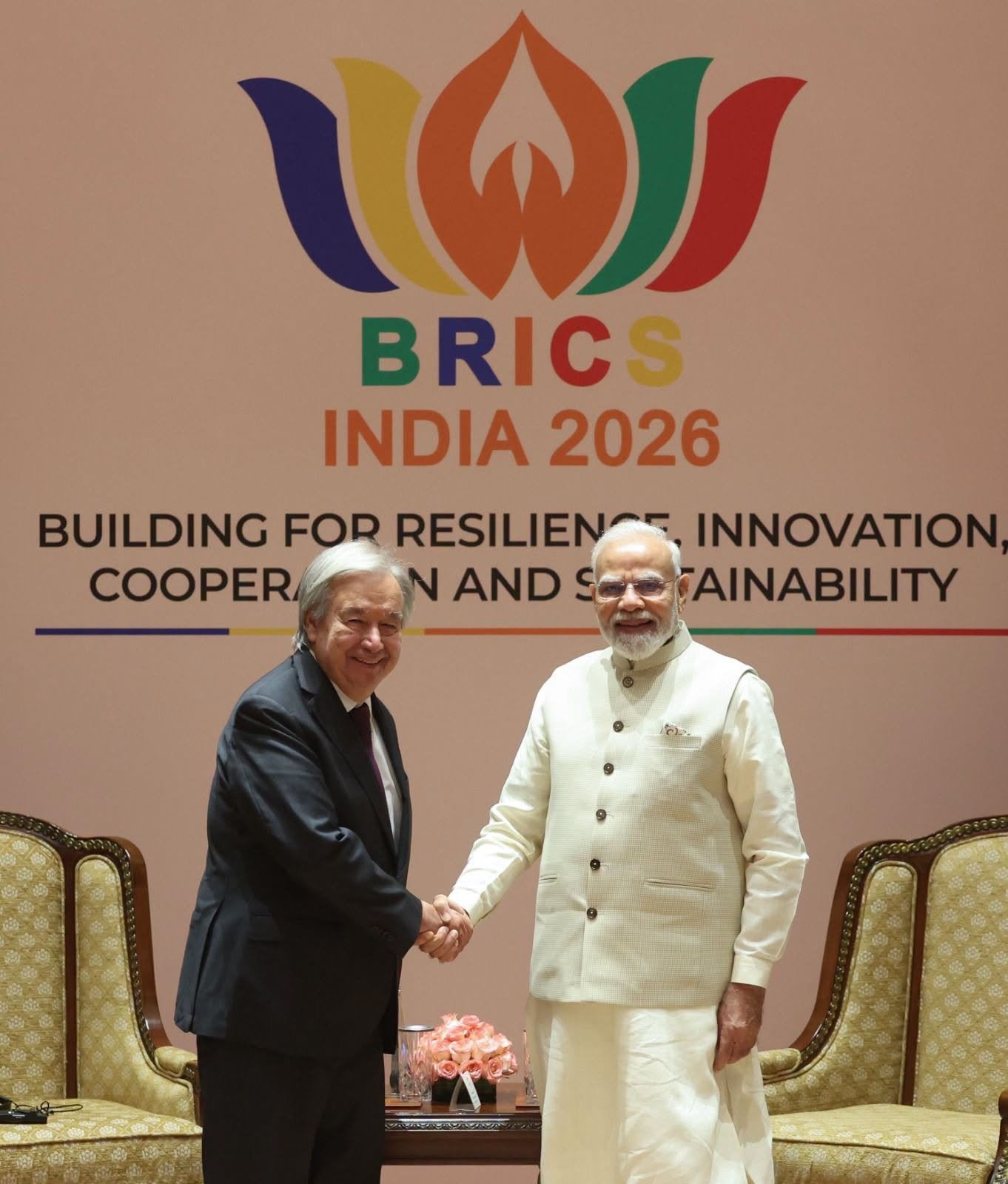
GTNS, SEPTEMBER 11, 2026 , NEW DELHI: Prime Minister Narendra Modi held a significant meeting with United Nations Secretary-General António Guterres in New Delhi as India prepares to host the 18th BRICS Summit, bringing the future of multilateralism and reform of global institutions into sharper focus.
The discussion centred on India’s BRICS presidency, strengthening multilateral cooperation and the urgent need to make the United Nations more representative and effective in responding to today’s geopolitical and economic challenges.
The meeting comes at a critical moment for the international system, with conflicts in different regions, disruptions to global trade and growing calls from developing nations for greater representation in institutions created decades ago.
INDIA PUTS REFORM OF GLOBAL GOVERNANCE ON THE BRICS AGENDA
Under India’s 2026 BRICS chairship, New Delhi has placed considerable emphasis on strengthening the voice of the Global South.
For India, BRICS is not intended to replace existing international institutions. Instead, New Delhi has argued that organisations such as the United Nations, international financial institutions and global trade bodies must evolve to reflect present-day economic and geopolitical realities.
India’s stated position is that reform should make multilateral institutions more inclusive, credible and capable of dealing with contemporary challenges.
THE SECURITY COUNCIL QUESTION
Reform of the UN Security Council remains one of India’s long-standing diplomatic priorities.
New Delhi has repeatedly argued that the current structure does not adequately represent today’s world, particularly the growing economic and demographic weight of Asia, Africa and Latin America.
India’s push for a stronger voice in global decision-making is closely connected with its wider Global South diplomacy.
The issue also featured prominently in earlier Modi-Guterres discussions this year, when both leaders underlined the need for urgent UN reform, including reform of the Security Council.
GUTERRES AND INDIA’S BRICS PRESIDENCY
The presence of the UN Secretary-General in New Delhi during India’s BRICS presidency gives additional weight to the discussion.
BRICS has grown into a major platform for emerging economies and now includes 11 members. The grouping represents a substantial share of the world’s population and economy, giving it increasing importance in debates over global governance.
India is seeking to use its chairship to focus on practical cooperation in areas such as innovation, startups, resilient supply chains, technology, green development and economic cooperation while also keeping global governance reform on the international agenda.
A MESSAGE FROM INDIA TO THE GLOBAL SYSTEM
The Modi-Guterres meeting carries a wider message: India wants a stronger multilateral system, but one that reflects the world as it exists today—not the power structure of the past.
New Delhi’s approach is particularly significant because India is simultaneously engaging major Western powers, Russia, China, the Gulf, Iran and countries across Africa and Latin America.
Rather than choosing one geopolitical camp, India is attempting to strengthen its influence across multiple platforms while maintaining strategic autonomy.
BRICS AND THE UNITED NATIONS: REFORM, NOT REPLACEMENT
India has previously made clear that BRICS should not be viewed as an organisation designed to replace the United Nations or other global institutions.
Instead, New Delhi has advocated using the collective weight of BRICS and the Global South to encourage reform of institutions such as the UN Security Council, multilateral development banks and the World Trade Organization.
That position could become increasingly important as BRICS expands and debates intensify over the future of the international economic and political order.
GLOBAL SOUTH SEEKS A BIGGER VOICE
For developing countries, the central issue is representation.
Economic power has shifted significantly since many international institutions were established, yet decision-making structures have not always changed at the same pace.
India’s BRICS presidency is therefore attempting to connect economic cooperation with a broader political objective: ensuring that developing nations have a meaningful role in shaping decisions on trade, finance, technology, climate, development and international security.
NEW DELHI’S DIPLOMATIC BALANCE
The Modi-Guterres meeting also highlights India’s effort to maintain a balanced approach to global diplomacy.
While BRICS is becoming more influential, India continues to work closely with the United States, Europe, Japan, Australia and other partners through separate bilateral and multilateral platforms.
New Delhi’s strategy is not to isolate any major power but to build a more diversified international system in which India and other developing countries have greater freedom to pursue their national interests.
A CRITICAL MOMENT FOR MULTILATERALISM
With the BRICS Leaders’ Summit beginning in New Delhi on September 12, the meeting between Modi and Guterres adds an important institutional dimension to India’s presidency.
The central question now is whether growing platforms such as BRICS can translate their demand for a more representative world order into practical reforms.
For India, the answer lies in strengthening—not weakening—multilateralism, while making global institutions more inclusive and responsive.
The Modi-Guterres engagement therefore goes beyond a routine diplomatic meeting. It reflects India’s larger ambition to place Global South priorities, UN reform and a more representative international order at the centre of the global conversation.
GTNS | NEW DELHI ,INDIA ; GTNS
SEPTEMBER 11, 2026