

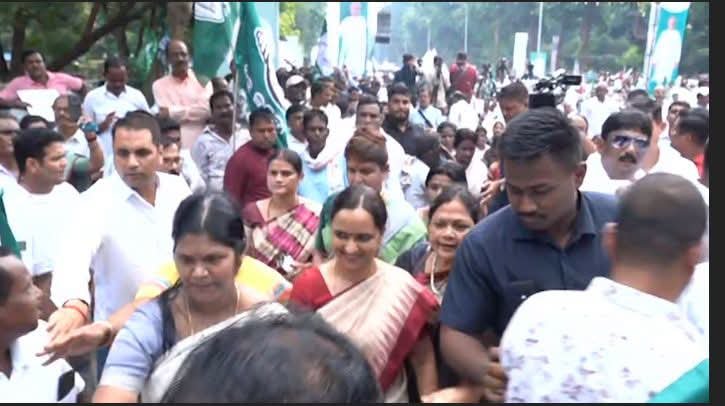
At Lower PMG, BJD leader questions BJP’s stand on Odisha’s mineral wealth and asks why the state’s interests were not defended in Parliament
BHUBANESWAR | GTNS, SEPTEMBER 28, 2026: The political temperature over the Mines and Minerals (Development and Regulation) Amendment Act rose sharply in Bhubaneswar on Monday as the Biju Janata Dal brought its opposition to the legislation onto the streets, with BJD leader Sujata Rout Pandian launching a pointed attack on the BJP and its handling of Odisha’s mineral interests.Speaking at the BJD’s protest at Lower PMG, Sujata questioned the political position taken by the BJP on the MMDR issue and particularly focused on the role of Odisha’s BJP MPs in Parliament.Her central argument was that Odisha’s mineral resources are not merely a source of government revenue but a major economic asset of the state, with mining-linked income capable of supporting public infrastructure and welfare programmes.‘Where were Odisha’s BJP MPs?’Sujata questioned why Odisha’s BJP MPs did not, according to her, raise stronger objections when the amended legislation was being considered in Parliament.She argued that the mineral wealth beneath Odisha’s soil has implications for the state’s long-term financial capacity and said elected representatives from the state should have placed Odisha’s interests at the forefront of the parliamentary debate.The BJD leader had made a similar argument in an earlier statement, alleging that the silence of Odisha’s 20 BJP MPs over the issue was a matter of concern. That allegation is part of the BJD’s political campaign against the amendment.Mining revenue became the heart of her argumentSujata also put the spotlight on Odisha’s mining revenue.She argued that stronger mineral-sector earnings could have provided additional resources for irrigation, education, farmers’ welfare and infrastructure development.At the Lower PMG gathering, she credited the previous Naveen Patnaik government’s mining policies for the growth of Odisha’s mineral revenue and challenged BJP leaders’ claims regarding the state’s mining-sector performance.Her remarks were framed as a direct political challenge to the BJP government and its explanation of the MMDR amendments.Sujata’s second line of attack: Odisha’s rightsThe BJD leader has also argued that the amended MMDR framework could affect the constitutional and financial rights of mineral-producing states.In her September 24 statement, she referred to the Supreme Court’s July 2024 nine-judge Constitution Bench judgment, which held that states have power to levy taxes on mineral rights and mineral-bearing lands. She alleged that the subsequent MMDR amendment undermines the benefit Odisha could have derived from that ruling.The BJD has also claimed that Odisha could have recovered substantial arrears and generated additional annual revenue following the Supreme Court judgment. These revenue figures are claims advanced by the BJD and are central to its political argument against the amendment.BJP-BJD confrontation moves beyond the AssemblyThe Lower PMG protest came against the backdrop of repeated disruptions inside the Odisha Assembly over the MMDR issue.On September 28, BJD and Congress members entered the Well of the House and protested near the Speaker’s podium, following which Speaker Surama Padhy adjourned proceedings shortly after the session began.The BJD’s street mobilisation now marks another stage in the confrontation. The party has announced plans to expand its campaign across Odisha, while the Opposition continues to demand withdrawal of the amendment.A new political flashpoint over Odisha’s mineralsFor the BJD, the MMDR amendment has become a larger argument about Odisha’s mineral wealth, state revenue and the balance of powers between the Centre and the state.For the BJP, the Opposition’s campaign has become a political challenge over how the legislation should be understood and implemented.At Lower PMG, however, Sujata Rout Pandian’s message was unmistakable: she sought to turn the MMDR debate from a technical mining-law issue into a public discussion about who controls the economic value generated from Odisha’s natural resources and who should defend the state’s interests in Parliament.With the BJD preparing to take the agitation beyond Bhubaneswar, the MMDR controversy is now firmly established as one of the major political flashpoints of Odisha’s ongoing Assembly session.
GTNS, 28 SEPTEMBER 2026