

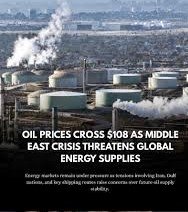
Saudi oil infrastructure hit, Strait of Hormuz diplomacy delayed and shipping risks intensify as markets brace for wider energy and inflation pressures
INDIA ; GTNS, SEPTEMBER 14, 2026, A fresh wave of instability across the Middle East is sending another warning through the global economy, with Bren crude rising to around $108 a barrel as attacks on energy infrastructure and growing risks around major shipping routes raise fears of further disruption to oil supplies.
The latest escalation has pushed energy markets back into the spotlight and is forcing investors, governments and central banks to reassess the economic consequences of prolonged regional instability. Reuters reported that Brent crude climbed about 3% on Monday, while the U.S. dollar strengthened as investors moved towards safer assets.
At the centre of the concern is Saudi Arabia’s East-West oil pipeline, an important alternative route for transporting Saudi crude without relying entirely on the Strait of Hormuz.
SAUDI PIPELINE DAMAGE ADDS TO SUPPLY FEARS
The pipeline was damaged in a drone attack and is expected to remain largely out of service for weeks while repairs are carried out, according to regional officials cited by the Associated Press.
The route can transport roughly 2.6 million to 4 million barrels of oil a day, making the disruption significant for an already nervous energy market.
The attack has added pressure to an energy system already affected by insecurity around the Gulf and surrounding maritime routes.
HORMUZ REMAINS THE BIGGEST GLOBAL FLASHPOINT
The Strait of Hormuz, through which a substantial share of the world’s oil shipments normally pass, remains at the centre of international concern.
Diplomatic discussions concerning the strategic waterway were postponed as regional tensions continued to rise. At the same time, attacks involving shipping have increased concerns that the crisis could affect not only crude supplies but also the wider movement of goods through the region.
The situation has created a difficult calculation for energy-importing countries: even if alternative pipelines remain available, attacks on those routes demonstrate that bypassing Hormuz does not automatically remove geopolitical risk.
HOUTHI ATTACKS WIDEN THE SECURITY CHALLENGE
The crisis is also spreading across the Red Sea region.
Iran-backed Houthi forces in Yemen have intensified attacks and have claimed control over strategically important islands near the Bab el-Mandeb Strait, another major maritime gateway linking the Red Sea with the Gulf of Aden.
The developments have increased concerns over Saudi Arabia’s ability to move energy safely through alternative export routes.
For global markets, the combination of Hormuz uncertainty, Red Sea insecurity and damage to Saudi infrastructure creates a much broader supply-risk picture than a single pipeline disruption.
OIL PRICE PRESSURE IS NOW AN INFLATION STORY
The jump in crude prices is no longer simply an energy-market issue.
Higher oil prices can feed into the cost of diesel, petrol, aviation fuel, shipping, manufacturing and transportation. Those increases can eventually reach consumers through higher prices for goods and services.
That is particularly significant for central banks already struggling with inflation.
In the United States, markets were pricing in roughly a 90% probability of a Federal Reserve interest-rate increase on Wednesday, according to Reuters reporting. Rising energy costs are adding another complication to the central bank’s inflation calculations.
DOLLAR STRENGTHENS AS INVESTORS SEEK SAFETY
The geopolitical shock is also reshaping financial markets.
The U.S. dollar strengthened on Monday as investors moved towards safer assets, while global bond yields moved higher. The dollar index rose nearly 0.6%, according to Reuters.
The market reaction shows how quickly a regional conflict can move through the international financial system.
Oil prices affect inflation. Inflation affects interest rates. Interest rates influence currencies, bonds, investment and economic growth.
That chain is now becoming increasingly visible across global markets.
GULF ECONOMIES UNDER PRESSURE
Stock markets across the Gulf region also reacted to the heightened security concerns.
Saudi equities were affected by worries surrounding energy infrastructure and shipping security, while major companies including Saudi Aramco experienced pressure during trading.
Investors are particularly sensitive to any development that could threaten the kingdom’s ability to export crude through secure routes.
The issue is therefore not only about how much oil is physically lost from the market, but also about how much additional risk traders attach to every barrel moving through the region.
THE WORLD ECONOMY FACES A NEW TEST
The latest developments come at a sensitive moment for the global economy.
If oil prices remain elevated for an extended period, countries dependent on imported energy could face higher import bills, renewed inflation and pressure on currencies.
Airlines, shipping companies, manufacturers and transport operators could also face higher operating costs.
Developing economies could be particularly vulnerable because higher energy prices can increase both inflation and trade deficits.
DIPLOMACY NOW MATTERS AS MUCH AS OIL
The central question for world markets is increasingly whether diplomacy can prevent the energy crisis from becoming a prolonged global economic shock.
The postponement of talks over the Strait of Hormuz has increased uncertainty, while continuing attacks in the region are making the security environment more difficult.
The longer the disruption continues, the greater the possibility that businesses will begin pricing a sustained period of expensive energy into their operations.
A GLOBAL WARNING FROM A REGIONAL CRISIS
The current oil shock demonstrates how interconnected the modern global economy has become.
A drone attack on a pipeline in Saudi Arabia can influence crude prices in international markets. A security incident near a shipping route can affect freight costs thousands of kilometres away. And higher fuel prices can ultimately influence household budgets and central-bank decisions.
With Brent crude now around $108 a barrel, investors are watching the Middle East not simply as a military and diplomatic crisis, but as a potential global economic turning point.
For governments around the world, the immediate priority is no longer only securing oil supplies. It is preventing a regional conflict from developing into a broader energy, inflation and financial crisis.