

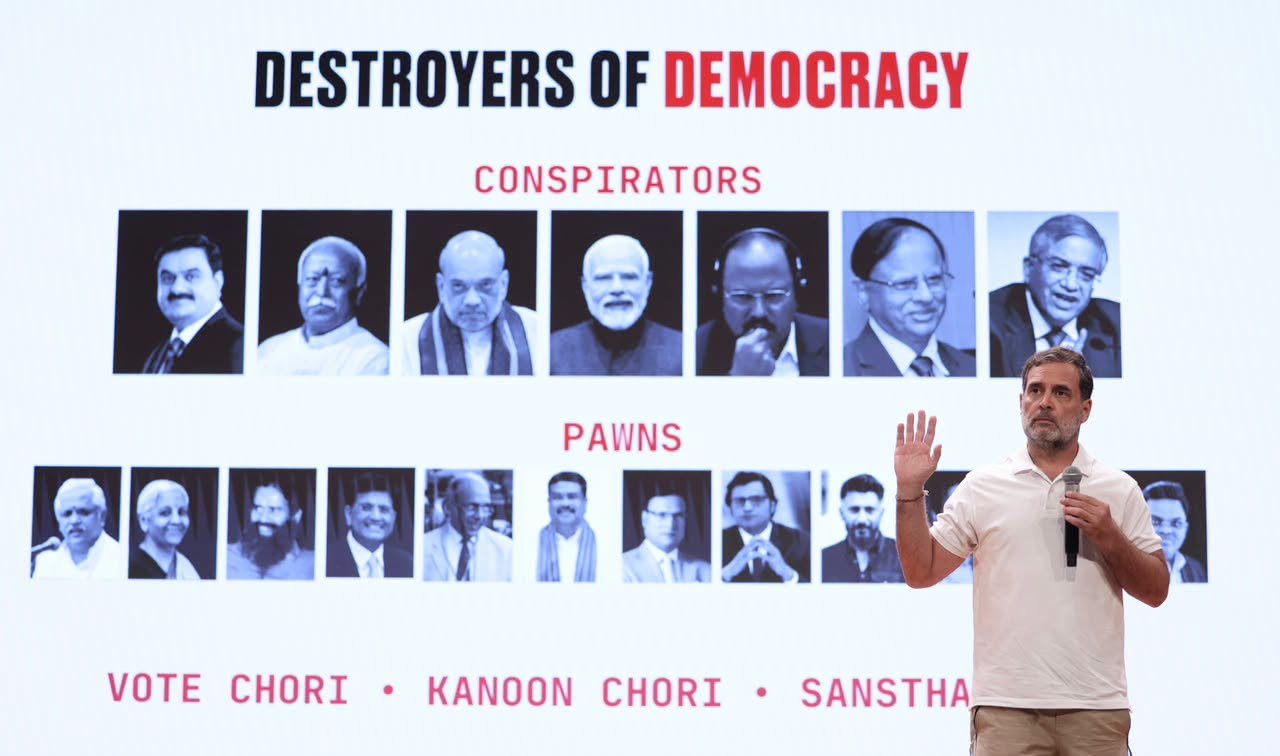
Congress alleges political interference in the Election Commission’s functioning as Supreme Court scrutiny brings the poll panel’s decision-making process under focus.
GTNS | OCTOBER 5, 2026
NEW DELHI: The political confrontation over electoral-roll revision intensified on Monday after the Congress launched a sharp attack on Chief Election Commissioner Gyanesh Kumar, alleging that the Election Commission’s functioning has raised serious questions about institutional independence and constitutional safeguards.
Congress general secretary in-charge of communications Jairam Ramesh alleged that the CEC had acted at the behest of Prime Minister Narendra Modi and Union Home Minister Amit Shah. He accused the CEC of violating the Constitution and questioned the manner in which several decisions connected with the electoral process were taken.
The allegations came amid a wider controversy surrounding the Special Intensive Revision (SIR) of electoral rolls and the disputed modification associated with Form 6, which is used by eligible citizens to seek inclusion in electoral rolls.
Supreme Court Seeks Records
The controversy gained fresh legal significance after the Supreme Court issued notices to the Election Commission and the Centre on a petition challenging the manner in which decisions were allegedly taken by the poll panel.
A bench headed by Chief Justice of India Surya Kant, along with Justices Joymalya Bagchi and V. Mohana, said it would examine the records relating to the disputed decisions.
The court observed that decisions of the Election Commission are required to be taken either unanimously or by majority. It also indicated that if any decision is found to be contrary to law, appropriate consequences could follow.
However, the Supreme Court has not passed an interim order suspending the CEC. The matter remains under judicial consideration.
Form 6 Becomes Key Flashpoint
The Form 6 controversy has become one of the central issues in the political confrontation.
During Monday’s hearing, Chief Justice Surya Kant made it clear that the Supreme Court had not approved any modification of Form 6 and said the court would examine the records to determine who authorised or carried out the change.
The development immediately triggered a fresh political response from Congress leader Rahul Gandhi, who alleged that the CEC had changed Form 6 “illegally and unilaterally.”
The Election Commission, however, has rejected Rahul Gandhi’s interpretation and described the allegation as misleading, defending the legal basis of the SIR-related process.
Congress Questions Election Commission’s Independence
The Congress has linked the Form 6 controversy with its broader criticism of the SIR exercise.
The party has alleged that electoral-roll changes and deletions have not always followed adequate safeguards and due process. It has also questioned whether decisions concerning SIR and voter registration were taken collectively by the Election Commission.
The controversy intensified after reports that Election Commissioners Sukhbir Singh Sandhu and Vivek Joshi had raised objections on several occasions regarding SIR-related orders and decisions. The Election Commission has maintained that differences of opinion during institutional deliberations are normal and that its orders carry legal sanction.
Congress Demands Accountability
The Congress has demanded greater transparency from the Election Commission and has called for accountability over the decisions now under scrutiny.
Jairam Ramesh argued that the Supreme Court’s intervention provides an opportunity to examine the functioning of the poll panel and restore public confidence in an institution central to India’s democratic system.
The Opposition’s criticism has also expanded beyond Form 6, with several parties questioning the wider SIR exercise and the impact of electoral-roll revisions on voters.
Legal and Political Battle Intensifies
The controversy now has both a political and judicial dimension.
While the Congress has accused the CEC of acting under political influence, the Election Commission has rejected the allegations and defended its decisions. The Supreme Court has not yet reached a final conclusion on the allegations and is seeking records and responses from the concerned authorities.
The next stage of the proceedings could therefore be crucial in determining how the disputed decisions were taken, who authorised the Form 6 modification and whether the procedures followed were consistent with the legal framework governing the Election Commission.
For now, the allegations made by Congress leaders remain political claims, while the Supreme Court’s examination of the records is continuing.