

Mining policy moves beyond legislation as the political contest expands into a wider debate over Odisha’s resources, investment, industrial growth, employment and the state’s economic future
BHUBANESWAR, GTNS, SEPTEMBER 13: Odisha’s vast mineral wealth has emerged as a fresh political battlefield, with the ruling Bharatiya Janata Party and Opposition Biju Janata Dal taking increasingly different positions over changes in the mining regulatory framework.
What began as a debate over mining legislation is now developing into a much broader political argument involving state revenue, natural-resource management, industrial investment, employment and Odisha’s economic interests.
The issue carries particular weight in Odisha because mining is closely linked to the state’s industrial economy. Iron ore, coal, bauxite, chromite and manganese have supported major industries and generated significant economic activity across several mineral-rich districts.
The latest political confrontation therefore raises a larger question: how should Odisha manage its natural wealth so that mining contributes not only to industrial growth but also to long-term public benefit?
BJD PUTS ODISHA’S ECONOMIC INTERESTS AT THE CENTRE
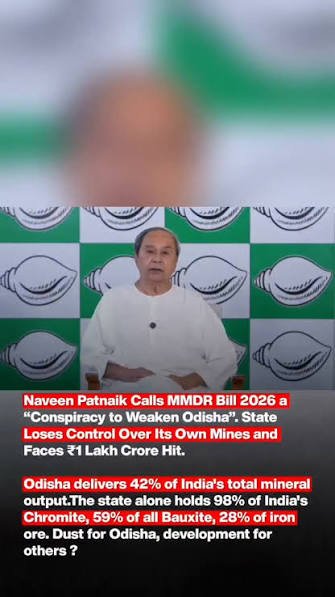
Former Chief Minister and BJD president Naveen Patnaik has strongly questioned the changes to the mining framework.
The BJD has argued that the interests of Odisha must remain central whenever decisions are taken concerning the state’s mineral resources and the revenue generated from them.
The party has also sought intervention against the mining changes, attempting to turn the issue into a wider political campaign.
For the BJD, the political opportunity is clear.
After losing state power in the 2024 Assembly election, the party is looking for issues that can reconnect it with voters and reinforce its identity as a regional political force.
Mining provides such an opportunity because it directly touches Odisha’s economic interests.
The party can frame the debate around a simple political proposition: Odisha possesses the resources, so Odisha’s interests must remain protected when those resources are developed and commercially utilised.
BJP DEFENDS REFORM AND DEVELOPMENT APPROACH
The BJP government has rejected the Opposition’s criticism and defended the broader direction of mining reform.
The ruling party has argued that changes to the mining system should be viewed through the requirements of transparency, investment, industrial expansion and economic growth.
The BJP has also sought to challenge the BJD’s record in the mining sector, making the controversy part of a larger comparison between the previous government and the present administration.
For Chief Minister Mohan Charan Majhi, the mining question is particularly important because his government is simultaneously attempting to position Odisha as an attractive destination for large-scale investment.
A mining policy that encourages investment can support industrial expansion.
But the government also has to demonstrate that such growth will translate into tangible benefits for Odisha.
That includes revenue, employment, infrastructure and development in mineral-producing districts.
WHY THE MINING DEBATE MATTERS BEYOND THE POLITICAL CLASS
The significance of the controversy extends far beyond political statements in Bhubaneswar.Mining affects a wide economic chain.
It influences transportation, industrial production, construction, logistics, employment, local businesses and government revenue.
A change in mining policy can therefore have consequences for communities far away from the state capital.
For people living in mineral-rich districts, the central question is not necessarily the technical language of legislation.
Their concern is whether mineral wealth produces better roads, stronger infrastructure, more employment, improved public services and greater economic opportunities.
That makes mining an issue capable of connecting state-level politics with everyday public concerns.
FROM MINING TO MANUFACTURING: THE NEXT ECONOMIC QUESTION
Odisha’s political debate is also taking place against a larger economic transformation.
The state government has been promoting investment in manufacturing, downstream industries, logistics, technology, food processing and other sectors.
This creates an important opportunity.
Instead of simply extracting minerals and sending raw materials outside the state, Odisha can seek greater value addition through processing and manufacturing within the state.
Such a strategy could create a larger economic chain:
Mineral resources → processing → manufacturing → investment → exports → employment.
If this model succeeds, Odisha could gain considerably more economic value from its natural resources.
But it also places greater responsibility on policymakers to ensure that industrial development is environmentally sustainable and that affected communities receive meaningful economic benefits.
THE JOBS QUESTION COULD BECOME CENTRAL
For Odisha’s younger generation, the mining debate will ultimately be judged through employment.
Investment announcements and mining revenue figures may be politically impressive, but young people are likely to ask a more direct question:
Where are the jobs?
If mining and industrial investment generate substantial employment, the government can use those outcomes to strengthen its development narrative.
If employment growth fails to match expectations, the Opposition will have an opportunity to question the government’s economic claims.
This makes employment one of the most important links between mining policy and electoral politics.
A MAJOR TEST FOR THE MOHAN CHARAN MAJHI GOVERNMENT
The controversy presents the Majhi government with a complicated political balancing act.
It must encourage investment while protecting the state’s economic interests.
It must promote mining while addressing concerns of local communities.
It must expand industrial activity while ensuring that development produces employment.
And it must demonstrate that Odisha’s mineral wealth is contributing to a broader development strategy rather than simply increasing extraction.
The success or failure of that balance could influence how voters assess the government’s economic performance.
A POLITICAL OPENING FOR NAVEEN PATNAIK
For Naveen Patnaik, the mining issue provides an opportunity to sharpen the BJD’s Opposition strategy.
The former Chief Minister remains the most recognisable face of the regional party.
But the BJD now faces the difficult task of rebuilding its political organisation after its 2024 defeat.
To regain momentum, the party needs to convert major public issues into a sustained political programme.
Mining can be one such issue.
However, the BJD will need to connect the subject with broader concerns such as employment, farmers, industrial development, tribal communities, welfare and district-level development.
Only then can a mining controversy develop into a wider political movement.
THE NEXT BATTLE WILL BE AT THE GRASSROOTS
The BJP-BJD confrontation over mining is taking place at a time when both parties are preparing for the next phase of grassroots politics.
The BJP is attempting to strengthen its organisational network after its historic breakthrough in 2024.
The BJD is trying to preserve and rebuild the grassroots structure that supported its long period in government.
The political significance of the mining issue could therefore extend into future local electoral contests.
If the BJD successfully converts the controversy into a grassroots campaign, it could strengthen its Opposition position.
If the BJP succeeds in linking mining reform with investment and development, it could reinforce its claim that the new government is changing Odisha’s economic direction.
THE BIGGER POLITICAL QUESTION
At the heart of the dispute lies a question much larger than the BJP and BJD.
Who should benefit most from Odisha’s natural wealth?
The government’s answer is likely to emphasise investment, industrialisation and economic expansion.
The Opposition’s argument focuses more strongly on state interests, revenue and control over resources.
Both positions will now compete for public support.
The final judgment will not be made through political statements alone.
It will depend on whether Odisha can convert its enormous natural-resource advantage into jobs, industries, infrastructure, revenue and improved living standards.