
The literary gift brings Tamil classical wisdom into the India-Russia dialogue as the two leaders deepen strategic and economic engagement
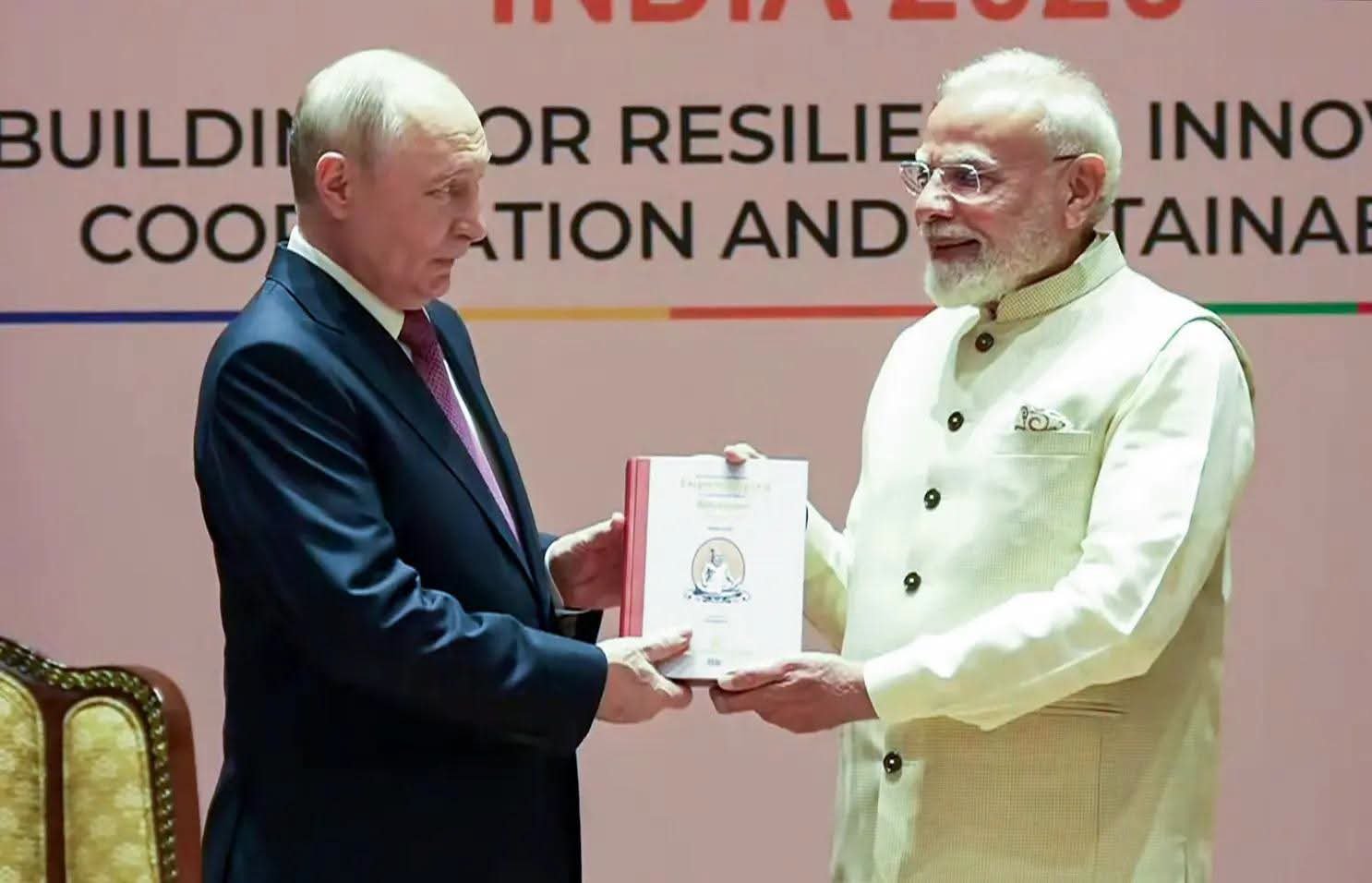
NEW DELHI , GTNS , SEPTEMBER 11, 2026: Prime Minister Narendra Modi presented Russian President Vladimir Putin with a Russian-language edition of the Thirukkural, adding a distinctive cultural dimension to the India-Russia engagement surrounding the BRICS 2026 Summit in New Delhi.
The presentation was significant because the Thirukkural is not simply a literary work but one of the most influential texts of Tamil intellectual and ethical tradition. Attributed to the poet and philosopher Thiruvalluvar, the classic consists of 1,330 couplets, organized around three broad themes—virtue, material or social life, and love.
Modi Presents Russian Translation of Thirukkural to Putin
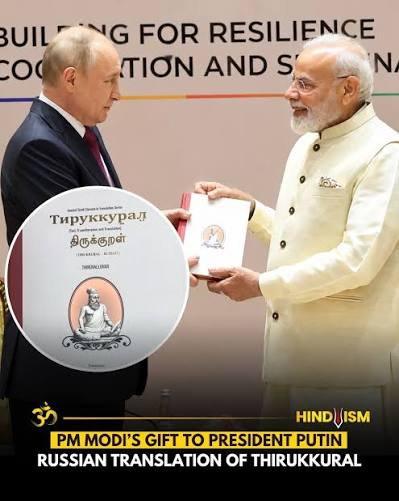
By presenting the Russian translation, Modi brought a work originating in Tamil civilisation into a high-level India-Russia diplomatic setting. The gesture can be viewed as an example of cultural diplomacy, using literature to communicate ideas that extend beyond national boundaries and contemporary political differences.
The Thirukkural deals with subjects such as ethical behaviour, responsible leadership, social duties, relationships and the conduct of public life. Its compact couplets have allowed the work to travel across linguistic and cultural boundaries through translations.
A CULTURAL DIMENSION TO STRATEGIC TIES
The literary exchange came as India and Russia were also discussing practical areas of cooperation. Modi and Putin reviewed the broader bilateral relationship, including economic, energy, defence and industrial cooperation, while also discussing international and regional developments.
The two leaders subsequently visited an India-Russia industrial exhibition, where technology and industrial capabilities were showcased. The exhibition included areas such as artificial intelligence, aviation, space, nuclear science, heavy engineering, mining and banking.
This combination of literature, industry and strategic diplomacy gave the Modi-Putin engagement a broader character than a conventional political meeting.
WHY THE THIRUKKURAL MATTERS
The Thirukkural is particularly notable for the breadth of its subject matter. Its teachings address personal conduct as well as questions of governance, social responsibility and human relationships.
The Russian edition therefore serves as more than a translated book. It allows a major work of Indian classical thought to be presented directly to the Russian leadership in a language accessible to Russian readers.
Reports on the 2026 edition identify Naira Mkrtchyan as its translator, while the work has been described as a bridge between Tamil literary heritage and a wider international audience.
BEYOND POLITICS
The gesture also comes at a significant moment in India-Russia relations. The two countries are seeking to strengthen their long-standing strategic partnership while expanding cooperation in trade, energy, industry and technology. India and Russia have set an ambition of increasing bilateral trade from nearly $70 billion in 2024–25 to $100 billion by 2030.
Against this backdrop, the presentation of the Thirukkural offered a softer but meaningful element to the relationship—showing how cultural heritage can accompany discussions on commerce, security, technology and geopolitics.
For India, the moment also highlighted the country’s diverse civilisational heritage on an international diplomatic platform. A Tamil classical text reaching the Russian president in his own language demonstrated how India’s cultural diplomacy can draw upon traditions from different parts of the country.
The Modi-Putin exchange consequently carried two messages at once: India and Russia remain focused on strengthening their strategic partnership, while their relationship also has space for culture, literature and people-to-people understanding.
GTNS | NEW DELHI