

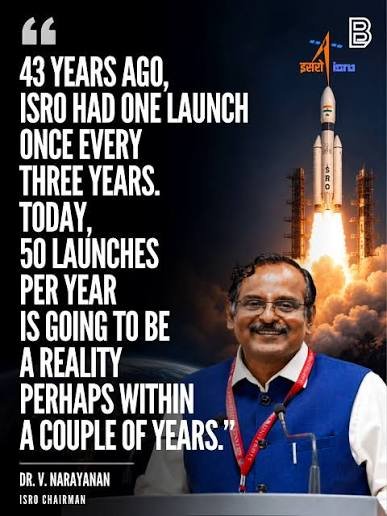
Chairman Dr. V. Narayanan recalls dramatic transformation from one launch every three years to a high-frequency space programme
BENGALURU: GTNS, SEPTEMBER 10, 2026; India’s space programme is preparing for a major expansion in launch activity, with ISRO Chairman Dr. V. Narayanan saying the country could move towards 50 rocket launches every year in the coming years.
Reflecting on his long association with the Indian Space Research Organisation, Dr. V. Narayanan, Chairman of ISRO, highlighted the extraordinary change in India’s launch capabilities.
He recalled that when he joined ISRO about 43 years ago, the organisation was conducting roughly one rocket launch once every three years. The proposed 50-launch annual target represents a dramatic increase in the scale and frequency of India’s space operations.
A bigger space ecosystem
Narayanan’s vision goes beyond increasing the number of launches conducted directly by ISRO. The space agency is encouraging a broader ecosystem involving Indian industry, private companies and other partners.
The ISRO chairman has stressed that greater private participation should not be confused with privatisation of ISRO. He has said the national space agency will remain a government institution, while private companies can contribute more extensively to manufacturing and other space-sector activities.
Industry to play a larger role
Around 450 Indian companies are already associated with ISRO’s programmes, according to Narayanan. He has also pointed out that a substantial share of expenditure connected with launch vehicles flows through Indian industry, underlining how closely the space programme is already linked with the wider industrial sector.
The emerging model would allow ISRO to concentrate more heavily on advanced technologies, scientific missions and strategic programmes while industry takes on a larger role in repeatable manufacturing and operational activities.
Infrastructure will be crucial
Achieving 50 launches annually will require India to expand its launch infrastructure and production capacity. New launch facilities, additional launch capacity and stronger industrial participation are therefore expected to become important components of the country’s long-term space strategy.
India is also progressing with major programmes including Gaganyaan and the Next Generation Launch Vehicle (NGLV), which are expected to strengthen the country’s capabilities in human spaceflight and advanced launch systems.
From cautious beginnings to a high-frequency future
Narayanan’s comparison between the early years of his career and the current ambitions of ISRO highlights the scale of India’s transformation in space technology.
From waiting years between launches to targeting dozens of missions annually, India is now seeking to build a space ecosystem capable of supporting a much higher launch cadence.
The 50-launch ambition, if achieved, would mark another major step in India’s evolution from a developing space programme into a high-frequency launch and space-technology power.
Global Times News | INDIA ; GTNS
SEPTEMBER 10, 2026