

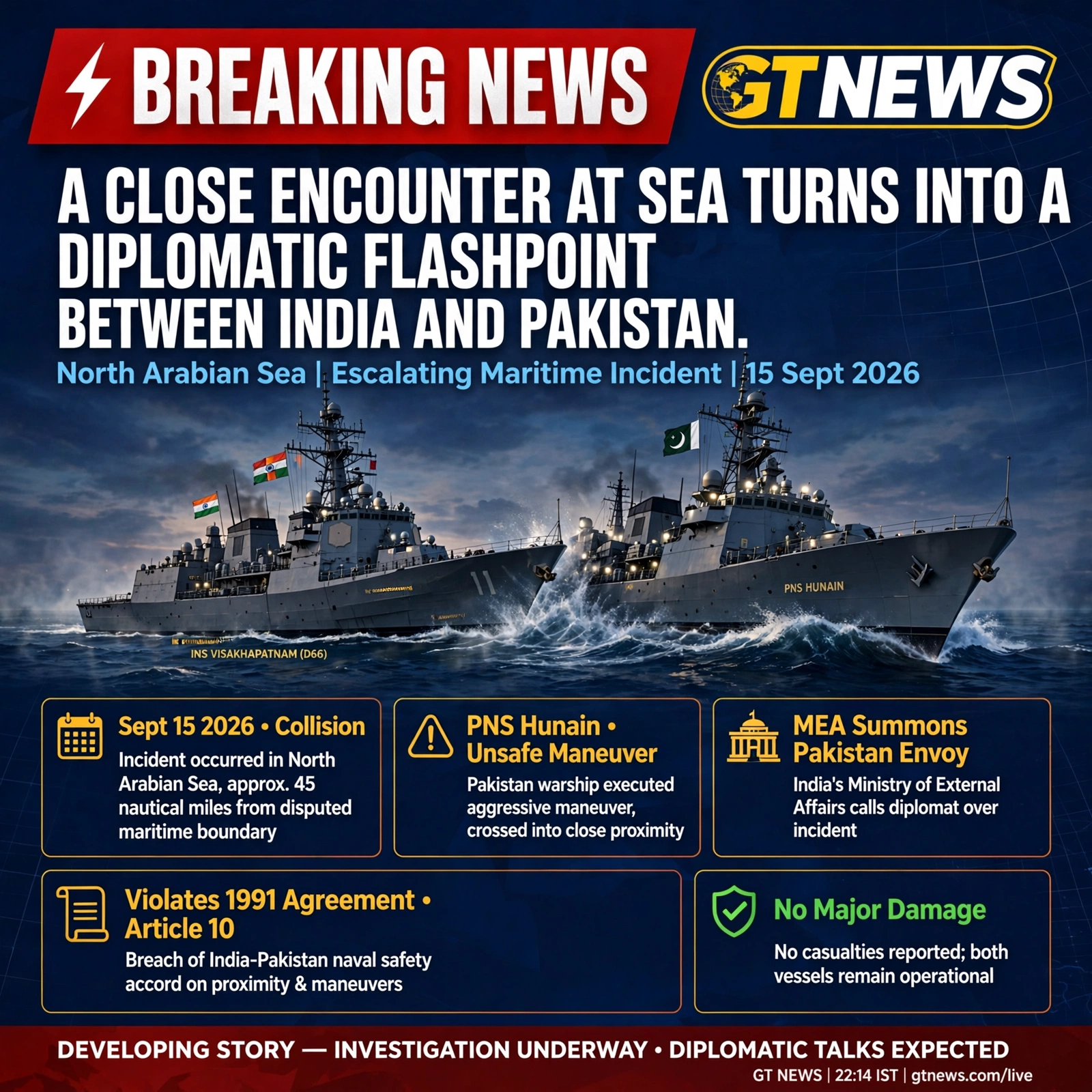
Pakistani naval vessel and Indian frontline warship collide in the North Arabian Sea; India cites unsafe maneuvering and a 1991 maritime-safety agreement
GTNS ,SEPTEMBER 16, 2026 , NEW DELHI: A routine naval surveillance mission in the North Arabian Sea turned into a diplomatic confrontation after a Pakistani naval vessel came into close proximity with an Indian frontline warship and the two vessels subsequently collided on the evening of September 15.
The incident took place in international waters, according to the Indian government. Indian officials said the Pakistani vessel approached at high speed and maneuvered in an unsafe and unprofessional manner, resulting in contact between the two ships.
The collision did not result in reported structural damage or injuries to personnel on the Indian side, and the Indian warship continued its operational mission.
But what began as a maritime encounter quickly moved into the diplomatic arena.
India summons Pakistan’s senior diplomat
India’s Ministry of External Affairs summoned Pakistan’s Charge ’Affaires in New Delhi on September 16 and lodged a formal protest over what it described as the “unacceptable and unprofessional” conduct of Pakistani naval units.
New Delhi also directed its Charge ’Affaires in Islamabad to raise the matter with Pakistan’s Foreign Ministry.
India said military vessels operating in international waters must exercise due care and follow the bilateral arrangements designed to prevent dangerous encounters.
1991 agreement becomes central to the dispute
The diplomatic response has brought a 1991 India-Pakistan agreement back into focus.
India said the Pakistani vessel’s conduct was in direct contravention of Article 10 of the Agreement on Advance Notice on Military Exercises, Manoeuvres and Troop Movements.
The provision includes safety-related requirements for naval vessels and submarines of the two countries operating in international waters, including maintaining a minimum separation intended to prevent accidents.
For New Delhi, therefore, the issue is not being treated simply as a navigation mishap but also as a question of compliance with an existing bilateral understanding.
PNS Hunain identified as the Pakistani vessel
Reports have identified the Pakistani ship involved as PNS Hunain, a Yarmook-class offshore patrol vessel.
The vessel was commissioned in 2024 and is designed for maritime surveillance, security and related naval operations. Reports said it was operating in the wider region as part of Pakistani naval activity.
Reports also said the Pakistani vessel later headed towards a Pakistani harbour following the incident. The extent of damage has been described differently across reports, while the Indian side has maintained that its warship suffered no structural damage.
Pakistan disputes India’s version
The incident has not produced a common account from the two sides.
Pakistan has lodged its own protest and accused the Indian vessel of dangerous and aggressive manoeuvring. Pakistani authorities have also disputed India’s description of where the incident occurred, according to Associated Press reporting.
The competing accounts mean that responsibility for the collision remains disputed between the two governments.
Why the location matters
The North Arabian Sea is a strategically important maritime zone carrying commercial shipping, energy traffic and naval activity.
An unexpected close approach between two military vessels can create risks beyond physical damage. Miscommunication, incorrect maneuvering or failure to maintain safe separation can rapidly turn a routine patrol encounter into a larger security incident.
That is why maritime safety procedures and established communication channels are particularly important when military vessels belonging to countries with strained relations operate in the same waters.
A reminder of an earlier naval incident
The latest collision has also revived memories of a 2011 encounter involving Indian and Pakistani naval vessels in the Gulf of Aden.
At that time, INS Godavari and Pakistan’s PNS Babur were involved in a separate maritime incident while operating in the area of an anti-piracy operation. The two countries offered differing accounts of that episode as well.
The comparison has renewed attention on the need for strict maritime discipline when the two navies operate in proximity.
The immediate concern: preventing another encounter
Despite the diplomatic exchange, the September 15 incident did not result in a reported loss of life or major operational damage to the Indian warship.
The immediate challenge is therefore to prevent a similar episode from escalating.
India has called on Pakistani military units to exercise due care and respect the relevant bilateral agreements. Pakistan, meanwhile, has maintained its own version of events.
The incident leaves the two governments facing a familiar but sensitive problem: how to manage close military encounters at sea without allowing a navigational incident to develop into a broader security confrontation.
For now, the collision remains a maritime safety incident with diplomatic consequences, rather than a reported armed engagement. The competing accounts from New Delhi and Islamabad will remain central to any further assessment of what happened in the North Arabian Sea on September 15.