

New policy package targets entry barriers, technology transfer and faster technology absorption as India seeks a wider domestic defence manufacturing base
GTNS ,SEPTEMBER 16, 2026 ,NEW DELHI: India’s defence-industrial strategy is moving towards a broader partnership model in which MSMEs, deep-tech start-ups, established manufacturers, research institutions and DRDO are expected to work across the full journey from technology creation to production.
The direction emerged at VIMARSH 2026, the DRDO-Industry Synergy Meet held in New Delhi on September 15, where Defence Minister Rajnath Singh announced a package of initiatives aimed at making it easier for smaller companies to enter the defence ecosystem and helping industries absorb indigenous technologies faster.
A NEW ENTRY GATE FOR SMALLER DEFENCE COMPANIES
A central feature of the new initiatives is an attempt to reduce the technical and financial hurdles that can prevent MSMEs and deep-tech start-ups from participating in defence production.
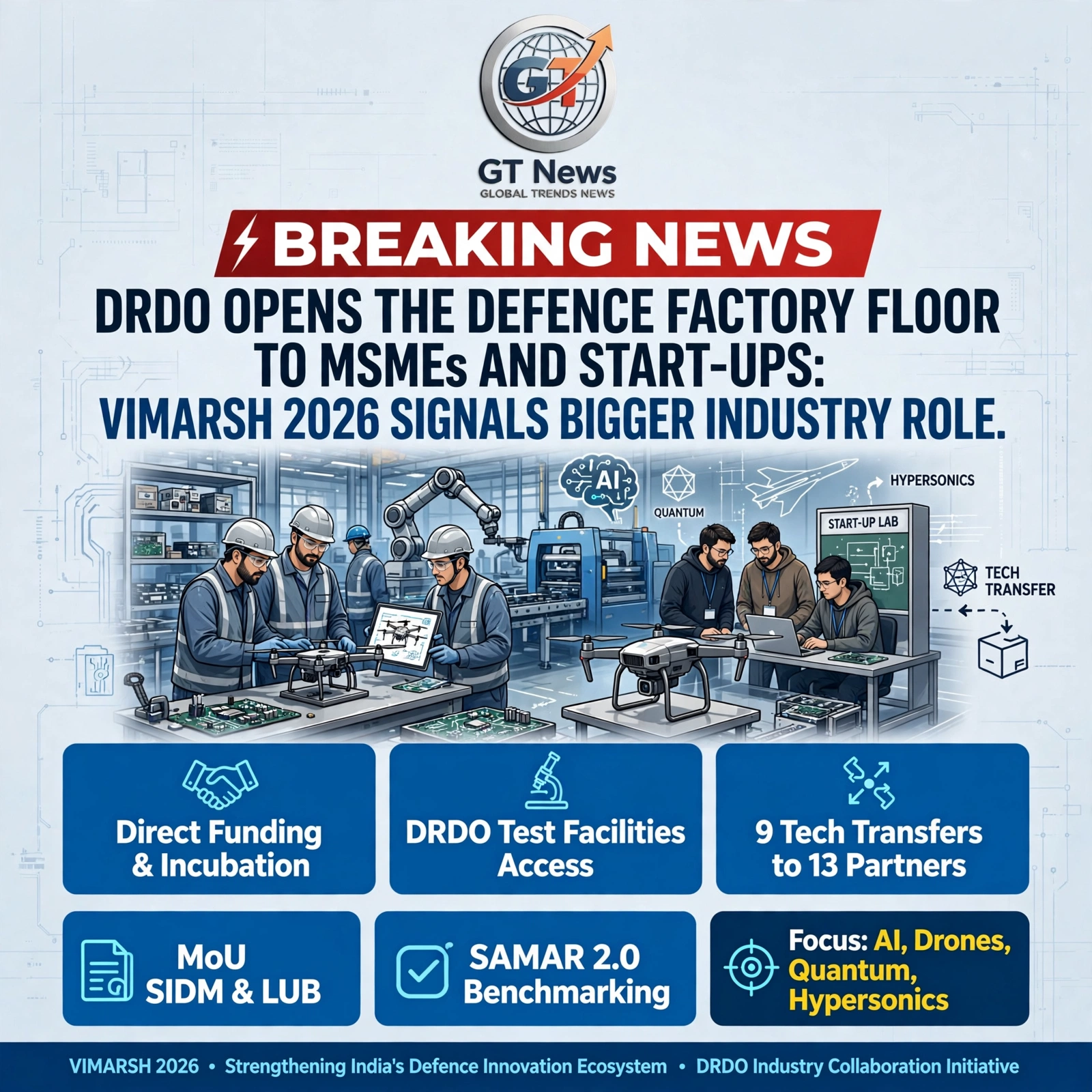
The framework provides for direct funding, incubation support and dedicated access to DRDO testing facilities.
The policy direction also focuses on industry-led research and development, mentoring for emerging companies and stronger academia-industry cooperation.
The intention is to expand the defence manufacturing base beyond a limited group of established players.
DRDO SOFTWARE SOURCE CODE TO GET A STRUCTURED INDUSTRY ROUTE
Another major announcement at VIMARSH was a standardised and secure framework for sharing DRDO-developed software source codes with licensee industries.
The initiative is intended to support the development of software-driven defence capabilities while helping industries address technological obsolescence.
As defence systems increasingly depend on software, secure access to relevant source-code frameworks can become an important part of maintaining and upgrading indigenous systems.
NINE TECHNOLOGY TRANSFERS MOVE TOWARDS PRODUCTION
The meeting also produced immediate technology-transfer outcomes.
Nine Licensing Agreements for Transfer of Technology (LAToTs) were handed over to 13 manufacturing partners, opening the route for commercial production of identified DRDO-developed systems.
Strategic MoUs were also exchanged with the Society of Indian Defence Manufacturers (SIDM) and Laghu Udyog Bharati (LUB) to widen industry outreach and encourage participation beyond major industrial centres.
DRDO separately entered into a contract with the Quality Council of India for System for Advance Manufacturing Assessment and Rating (SAMAR) 2.0, designed to benchmark the manufacturing maturity of domestic defence enterprises.
FROM PRODUCTION CONTRACTS TO THE ENTIRE VALUE CHAIN
Rajnath Singh said DRDO-industry cooperation should extend beyond the final production stage.
The proposed ecosystem covers research, design, testing, certification and manufacturing.
The logic is straightforward: DRDO contributes research and technological knowledge; industry brings manufacturing scale; start-ups contribute innovation and agility; and young researchers and entrepreneurs expand the technology pipeline.
The government is seeking to bring these capabilities into a more integrated system rather than treating them as separate parts of the defence sector.
MSMEs MOVE CLOSER TO THE CORE OF THE SUPPLY CHAIN
The Defence Minister described MSMEs and start-ups as important contributors to India’s defence innovation ecosystem, particularly because they can develop components and sub-systems for larger defence platforms as well as entirely new technologies.
The new policy initiatives specifically encourage investment in areas such as:
- Artificial intelligence
- Quantum computing
- Hypersonics
- Directed-energy technologies
- Drone technology
- Cyber security
These areas are expected to provide opportunities for smaller technology companies to participate in future defence requirements.
INDIA’S TECHNOLOGY-TRANSFER NETWORK IS EXPANDING
The scale of technology transfer already taking place through DRDO was highlighted at the meeting.
According to Defence Secretary and Secretary, Department of Defence R&D and DRDO Chairman Rajesh Kumar Singh, more than 2,300 Technology Transfers have so far been handed over to over 1,100 industries.
He also said technologies connected with approximately 50 DRDO-developed missiles have been made available to industry to encourage wider participation.
The expansion of technology transfer has also helped create parallel production capabilities for meeting the requirements of the Armed Forces, according to the Defence Secretary.
THE PRIVATE SECTOR GETS A LARGER TECHNOLOGY ROLE
Rajnath Singh also referred to several existing defence-sector initiatives, including the Positive Indigenisation Lists, Make in India, iDEX and ADITI, along with the decision to allocate 25% of the defence R&D budget to the private sector.
Start-ups are also receiving support through the Technology Development Fund, while the iDEX ecosystem has been designed to connect emerging companies with actual operational requirements.
The new initiatives at VIMARSH build on that architecture by focusing on easier access to testing, funding, mentorship and technology.
‘VARTA SE VIKAS’: MOVING FROM BUYER-SELLER TO CO-CREATION
VIMARSH 2026 was organised around the theme “Varta se Vikas”.
Rajesh Kumar Singh described the forum as an effort to move the defence ecosystem away from a simple buyer-seller relationship towards a collaborative and co-created technology model.
The objective is to connect commercial innovation with national defence requirements and bring private-sector capabilities closer to the core of the defence ecosystem.
SAMAR 2.0 AND A NEW FOCUS ON MANUFACTURING QUALITY
The partnership with the Quality Council of India adds another element to the industry’s expansion.
Through SAMAR 2.0, domestic defence enterprises will have a framework to assess and benchmark their manufacturing maturity.
For a growing defence manufacturing ecosystem, the challenge is not only increasing the number of suppliers but also ensuring that companies meet requirements relating to quality, delivery, innovation and global standards.
TECHNICAL ROADMAPS ACROSS FIVE MAJOR AREAS
The VIMARSH technical sessions brought together DRDO’s technological clusters to outline roadmaps covering:
Aeronautical Systems, Missiles, Armaments, Microelectronics and Naval Systems.
DRDO headquarters also introduced measures aimed at simplifying procedural compliance, accelerating access to facilities and shortening licensing timelines.
These measures are intended to reduce delays between technological development and industrial adoption.
THE NEXT CHALLENGE: GETTING TECHNOLOGY INTO SERVICE
A high-level panel involving DRDO, the Department of Defence Production and the Armed Forces discussed ways to accelerate technology absorption, improve Development-cum-Production Partner models and ensure faster induction of indigenous technologies into active service.
This stage is crucial because developing a technology is only one part of building a defence capability.
The larger objective is to move technologies through testing, production, induction and eventual scaling.
A BOOK DOCUMENTS DRDO’S TECHNOLOGY JOURNEY
VIMARSH also saw the release of “Defence Systems for Resilient Bharat – Advancing Aatmanirbharta in Defence”, a compilation documenting significant defence systems developed by DRDO’s technology clusters between 2014 and 2026.
Alongside it, DRDO released guidelines for Human Resource Outsourcing Service Contracts.
The guidelines provide a framework covering service specifications, selection of service providers, contract administration, performance monitoring and compliance with contractual and statutory requirements across DRDO laboratories.
250-PLUS INDUSTRY AND DEFENCE LEADERS AT VIMARSH
More than 250 defence industry leaders, representatives of industry chambers, senior civil and military officials and DRDO scientists attended the flagship event.
The Secretary, Department for Promotion of Industry and Internal Trade (DPIIT) also participated.
Senior officials present included Secretary (Defence Production) Sanjeev Kumar, Secretary (Defence Finance) Vishvajit Sahay and Distinguished Scientist and Director General (Production Coordination & Services Interaction), DRDO, Dr Chandrika Kaushik.
THE 2047 TARGET
The wider objective outlined at VIMARSH is linked to the government’s Viksit Bharat 2047 vision.
Rajnath Singh said the goal encompasses an economically strong, technologically self-reliant, socially inclusive, environmentally sustainable and strategically secure India.
In the defence sector, the stated targets include greater Aatmanirbharta in critical technologies, higher indigenous content, increased defence exports and a stronger presence in global supply chains.
THE NEW DEFENCE INDUSTRIAL EQUATION
VIMARSH 2026 ultimately places a larger question before India’s defence industry: can the country’s research strength, private manufacturing capacity and start-up innovation be connected quickly enough to create a globally competitive production ecosystem?
The policy package announced in New Delhi attempts to address that question through funding, testing access, technology transfer, software frameworks, manufacturing assessment, industry outreach and faster licensing.
The message from the meeting was therefore broader than a set of new agreements.
It was about changing the structure of participation itself—from a defence industry dominated by a limited manufacturing base to a wider network in which MSMEs and start-ups become active contributors to India’s technology, production and supply-chain capabilities.
GLOBAL TIMES NEWS | INDIA