
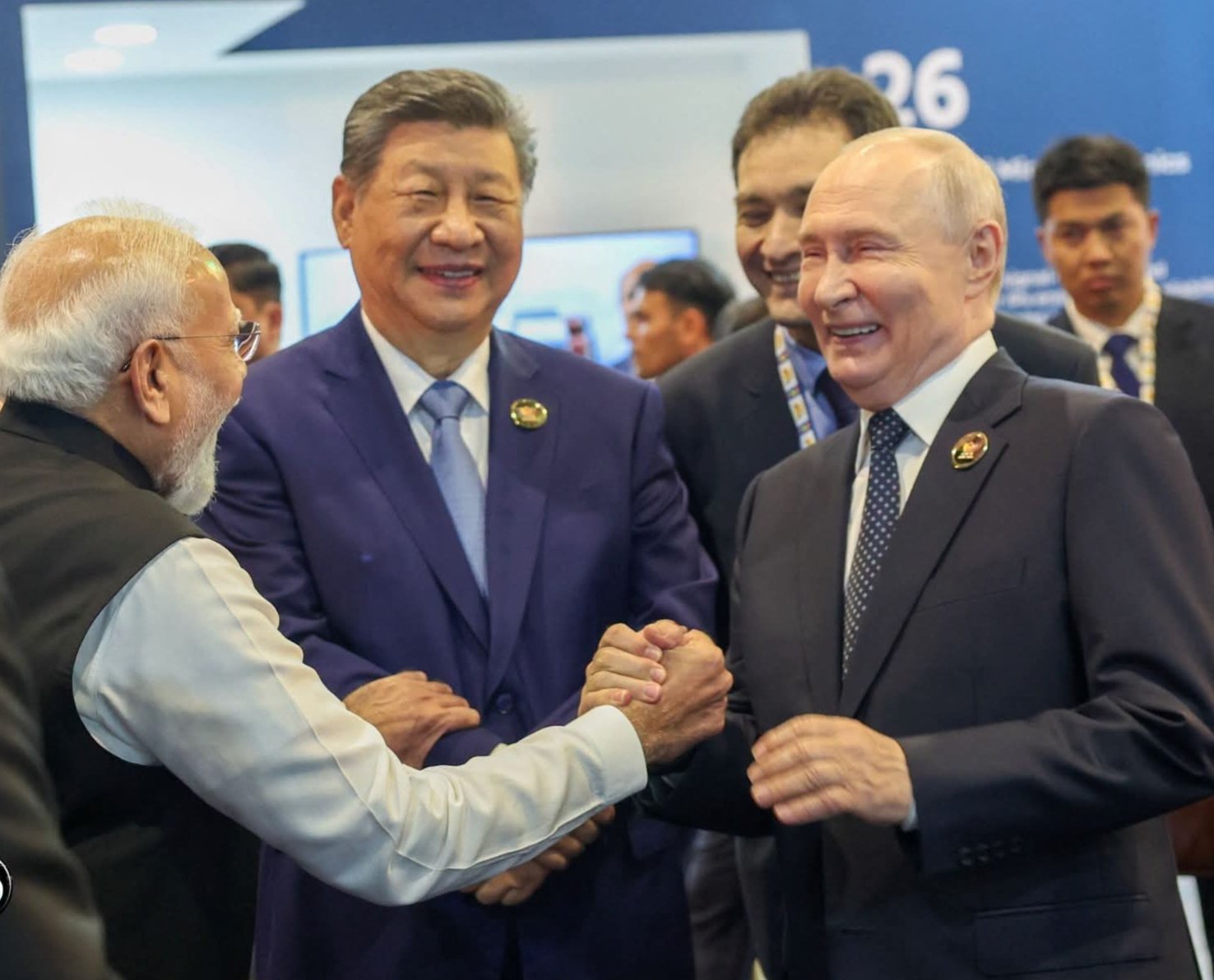
Narendra Modi, Xi Jinping and Vladimir Putin share smiles and a warm exchange at Bharat Mandapam, creating a powerful image of dialogue among three influential powers amid a rapidly changing global order.
NEW DELHI: A candid moment involving Indian Prime Minister Narendra Modi, Chinese President Xi Jinping and Russian President Vladimir Putin has emerged as one of the most talked-about images from the 18th BRICS Summit in New Delhi.
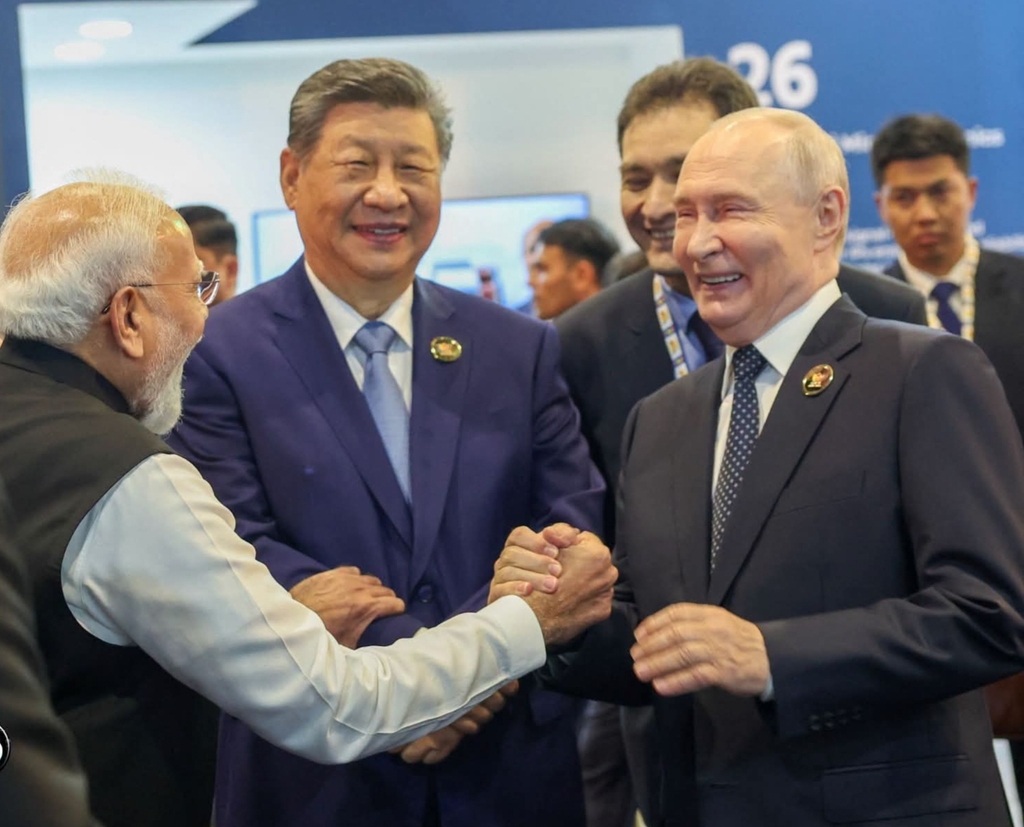
A candid moment involving Indian Prime Minister Narendra Modi, Chinese President Xi Jinping and Russian President Vladimir Putin has emerged as one of the most talked-about images from the 18th BRICS Summit in New Delhi.
The three leaders were seen together at Bharat Mandapam, smiling and sharing a relaxed interaction while holding hands. The unusual informality of the moment immediately attracted attention because it brought together the leaders of India, China and Russia—three major powers whose relationships have a significant bearing on Asian and global geopolitics.
What makes the photograph particularly striking is the wider international environment in which it was captured. Relations among major powers are being reshaped by conflicts, economic competition, trade pressures and debates over the future of global governance.
Three Leaders, Three Strategic Priorities
Prime Minister Narendra Modi is hosting the BRICS Summit as India exercises the group’s 2026 chairmanship. New Delhi has sought to position BRICS as a platform for cooperation among emerging and developing economies rather than an organisation directed against any particular country.
Chinese President Xi Jinping, meanwhile, arrived in India for his first visit in seven years. His presence has added considerable diplomatic importance to the summit, particularly because India and China have been working to stabilise relations after years of tensions.
Russian President Vladimir Putin is also a key figure in the summit’s geopolitical landscape. India and Russia maintain a longstanding strategic relationship covering defence, energy, trade and other areas. Modi and Putin also held bilateral discussions on the sidelines of the summit.
Why the Picture Matters
The photograph should not be interpreted as evidence that every disagreement among the three countries has disappeared.
India and China continue to manage complicated bilateral issues, including the boundary question and economic concerns. At the same time, Russia remains deeply involved in major international conflicts and faces extensive geopolitical pressure.
Yet the image demonstrates something important about BRICS: countries can maintain dialogue and personal diplomatic engagement even when their national interests do not completely overlap.
That characteristic is becoming increasingly important as BRICS expands its role in global affairs.
Modi-Xi Engagement Adds Another Layer
The photograph also comes at a particularly important moment in India-China relations.
Modi and Xi held a separate bilateral meeting on the sidelines of the summit and reviewed the broad spectrum of India-China relations. Xi has called for a strategic and long-term approach to bilateral ties, while Modi has emphasised continued engagement between the two countries.
Xi’s visit itself is significant because it represents his first trip to India in seven years and comes amid efforts by New Delhi and Beijing to improve the atmosphere in their relationship.
BRICS Becomes the Bigger Picture
The Modi-Xi-Putin interaction also captures the wider purpose of the BRICS platform.
The grouping now represents a substantial share of the world’s population and economy and has expanded beyond its original membership. Its agenda includes economic cooperation, development, global governance reform, trade, technology and the interests of the Global South.
Xi has also used the Delhi summit to underline China’s role in the group’s future, with China scheduled to take over the BRICS presidency next year and host the 19th summit.
A Photograph With a Larger Message
For the cameras, it was a brief moment of smiles and camaraderie.
For international observers, however, the image carries a wider diplomatic message.
Narendra Modi, Xi Jinping and Vladimir Putin standing together in Delhi represents three different strategic approaches meeting on one multilateral platform. India seeks strategic autonomy, China is pushing for a stronger role for the Global South, and Russia is strengthening partnerships beyond its traditional Western relationships.
The friendly moment does not erase differences. But it demonstrates that diplomacy can continue despite them.
As the BRICS Summit progresses, the real question will be whether the spirit of cooperation visible in this photograph can be converted into practical agreements on global governance, economic cooperation, peace and development.
For now, the Modi-Xi-Putin image has become one of the defining visual moments of the Delhi summit—a single frame reflecting the complexity of a world moving steadily toward a more multipolar order.
Global Times News | INDIA ; GTNS
SEPTEMBER 12, 2026