
MODI-PUTIN TALKS GO BEYOND DIPLOMACY AS INDIA-RUSSIA PARTNERSHIP ENTERS A NEW PHASE
Trade, defense, energy, nuclear cooperation, technology and global conflicts dominate the agenda as the two leaders meet ahead of the BRICS Summit .
New Delhi and Moscow seek to deepen an established strategic partnership through industry, investment, energy security, space cooperation and stronger economic links
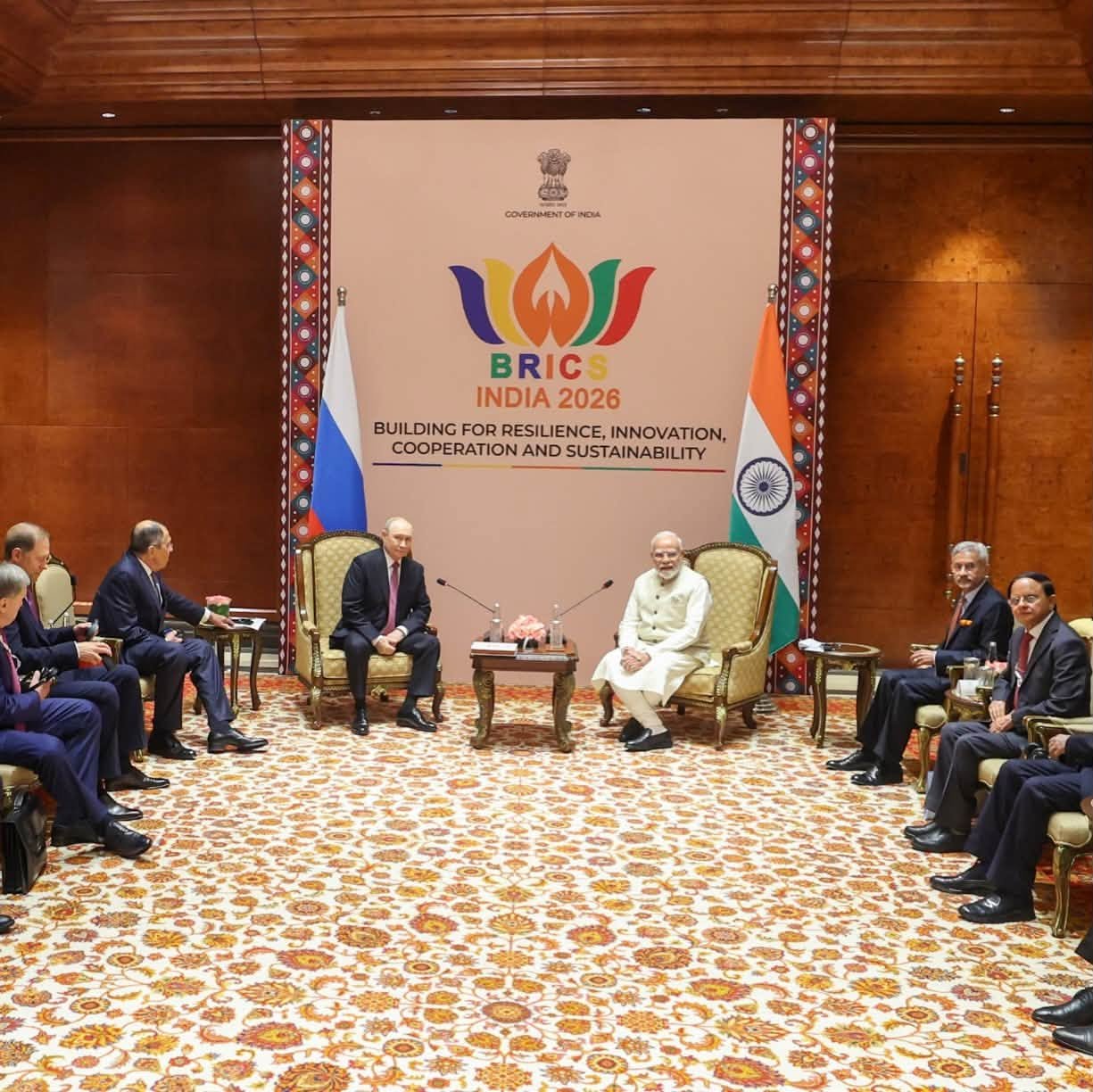
NEW DELHI , GTNS , SEPTEMBER 11, 2026: Prime Minister Narendra Modi and Russian President Vladimir Putin have used their latest meeting in New Delhi to underline the continuing strength of the India-Russia relationship while expanding its focus into newer economic, industrial and technological areas.
The meeting took place on the sidelines of the 18th BRICS Summit and came less than two weeks after the two leaders met in Bishkek on the margins of the Shanghai Cooperation Organisation summit. The repeated high-level engagement reflects the importance both governments attach to maintaining direct political communication.
A PARTNERSHIP WITH A BROADER ECONOMIC FOCUS
The discussions covered the full range of bilateral cooperation, including politics, the economy, defence, energy, space, skills mobility and people-to-people relations.
One of the central economic priorities is implementation of the Programme for Economic Cooperation 2030. India and Russia are also working towards increasing bilateral trade to $100 billion by 2030, from almost $70 billion in 2024-25.
Achieving that target would require the two countries to broaden trade beyond its existing concentration in major commodities and create greater opportunities in manufacturing, investment, technology and services.
For India, the objective is also to expand exports and attract greater Russian investment into Indian industrial and infrastructure projects.
INNOPROM PUTS INDUSTRY AT THE CENTRE
A major visual and economic element of the visit was the joint appearance of Modi and Putin at INNOPROM India at Bharat Mandapam.
The international industrial exhibition was held in India for the first time from September 9 to 11. The two leaders interacted with participants and viewed the industrial showcase.
The exhibition featured areas including artificial intelligence, aviation, space, nuclear science, heavy engineering, mining and banking, giving the bilateral relationship a strong technology and manufacturing dimension.
The message from the exhibition was significant: India-Russia cooperation is increasingly looking beyond government-to-government transactions towards industrial partnerships and business-to-business engagement.
ENERGY REMAINS A CRITICAL PILLAR
Energy continues to be one of the most important components of the relationship.
Russian crude has become a major part of India’s energy supply. According to Reuters, Russia’s share of India’s crude imports reached about 51% in July 2026, as disruptions in Middle Eastern supplies increased India’s dependence on alternative sources.
For New Delhi, reliable and affordable energy supplies are directly linked to economic stability. For Moscow, India represents one of the world’s major energy markets.
The relationship therefore has an important economic dimension for both sides, even as global sanctions, shipping disruptions and geopolitical tensions continue to affect international energy markets.
DEFENCE RELATIONSHIP IS EVOLVING
Defence remains a foundation of India-Russia relations, but the emphasis is increasingly moving towards technology, manufacturing and longer-term industrial cooperation.
India has historically sourced a substantial portion of its military equipment from Russia. The next stage of the relationship is expected to place greater emphasis on indigenous production, technology cooperation and joint development.
This approach fits India’s wider effort to strengthen domestic defence manufacturing while retaining established strategic partnerships.
NUCLEAR AND SPACE COOPERATION
Civil nuclear cooperation is another long-term component of the partnership.
Russia has been a major partner in India’s nuclear-energy programme, and nuclear cooperation remains strategically important as India seeks to increase electricity generation while diversifying its energy mix.
The two sides are also exploring opportunities in space and advanced technology, sectors that have both commercial and strategic significance. The official Indian account specifically lists space among the areas reviewed by Modi and Putin.
GLOBAL CONFLICTS ENTER THE DISCUSSION
The meeting was not confined to bilateral relations.
Modi and Putin exchanged views on the conflicts in West Asia and the Black Sea region, particularly their impact on maritime trade and the safety and security of Indian seafarers. Modi reiterated India’s position that dialogue and diplomacy are the preferred route for resolving conflicts.
For India, maritime security has a direct economic dimension because instability around major shipping routes can affect energy imports, freight costs, supply chains and the movement of Indian workers and seafarers.
BRICS ADDS A MULTILATERAL DIMENSION
The bilateral meeting also took place within the larger framework of India’s BRICS chairship.
India is attempting to use the 2026 BRICS platform to strengthen economic cooperation among emerging economies while simultaneously managing significant differences among member states on geopolitical issues.
The expanded BRICS grouping now comprises 11 members, representing a substantial share of global population and economic activity. At the same time, conflicts involving Ukraine and the Middle East are exposing differences among members.
India’s approach has therefore been to keep the organisation focused on cooperation while promoting dialogue on contentious international issues.
THIRUKKURAL BRINGS CULTURE INTO THE BILATERAL RELATIONSHIP
The meeting also contained a distinctive cultural moment.
Modi presented Putin with a Russian translation of the Thirukkural, the classical Tamil work associated with poet-philosopher Thiruvalluvar.
The work contains 1,330 couplets dealing with themes such as virtue, public life, relationships and human conduct. Presenting its Russian translation gave the bilateral engagement a cultural dimension beyond trade and geopolitics.
It also highlighted India’s approach of presenting its diverse civilisational traditions as part of its international engagement.
PUTIN INVITES MODI TO RUSSIA
The engagement will continue beyond the BRICS summit.
Putin invited Modi to Russia for the 24th India-Russia Annual Summit, and Modi accepted the invitation. The dates are expected to be finalised through diplomatic channels.
The forthcoming summit could provide an opportunity to assess progress on the economic and strategic commitments discussed in New Delhi.
WHAT THE NEXT PHASE WILL DEPEND ON
The biggest question now is implementation.
The political relationship between India and Russia remains strong, but the next phase will be measured by concrete outcomes—higher and more balanced trade, industrial investment, reliable energy supplies, new technology partnerships, defence manufacturing, nuclear cooperation and progress in space-related activities.
For India, Russia remains important for energy, defence, nuclear cooperation and strategic autonomy.
For Russia, India provides a major market and an important partner in the Global South at a time when Moscow’s relationship with Western countries remains deeply strained.
The Modi-Putin engagement therefore points towards an India-Russia relationship attempting to move from a historically defence-heavy partnership towards a wider economic and technological framework.
The success of that transition will depend not on diplomatic statements alone, but on whether agreements and political understanding are translated into factories, investment, technology, trade and long-term projects on the ground.
GTNS | NEW DELHI , INDIA ;
SEPTEMBER 11, 2026