
Bhubaneswar, September 5: Odisha’s banking sector is being called upon to play a larger role in the state’s economic transformation, with the government stressing stronger credit delivery, wider rural banking access and greater financial support for agriculture, MSMEs and women-led enterprises.
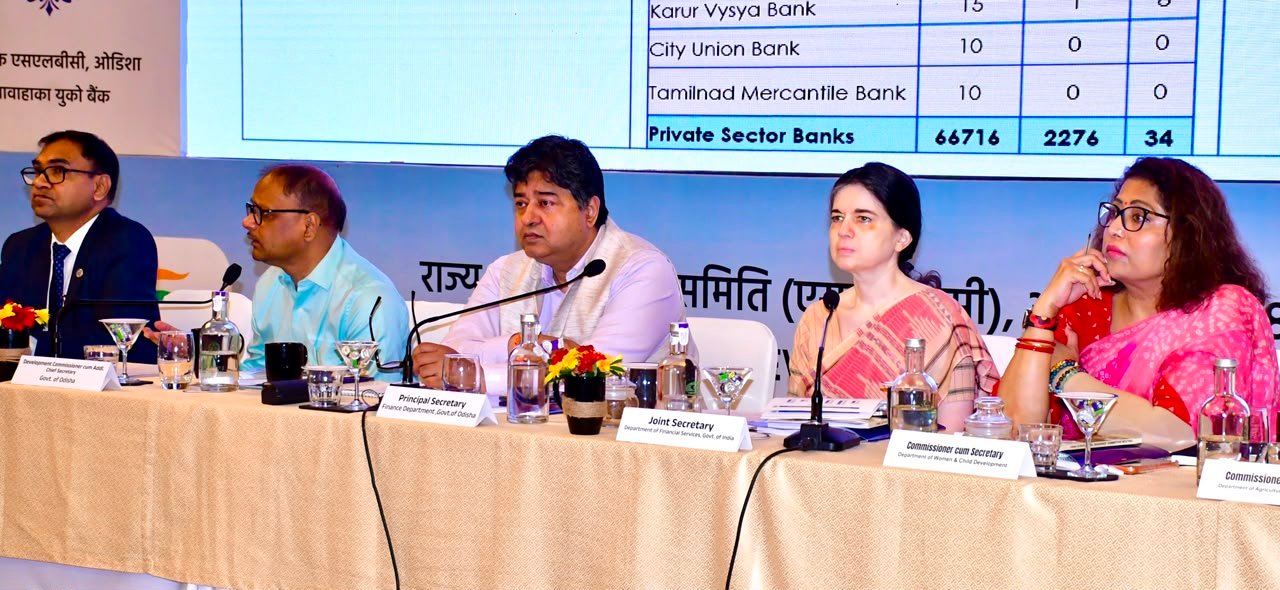
The message emerged from the 184th meeting of the Odisha State Level Bankers’ Committee (SLBC) held in Bhubaneswar on Friday, where senior government officials and banking representatives reviewed the sector’s performance up to June 2026 and discussed priorities for the current financial year.
Development Commissioner-cum-Additional Chief Secretary Deoranajan Kumar Singh, who chaired the meeting, said closer coordination between banks, government departments and district administrations would be essential to achieving the objectives of Samruddha Odisha 2036 and Viksit Bharat 2047.
Rather than viewing banking merely as a financial service, the meeting underlined its growing importance as an instrument for employment generation, entrepreneurship, rural development and investment.
Credit Flow Emerges as Key Challenge
A major focus of the deliberations was the state’s credit-deposit ratio. Joint Secretary in the Department of Financial Services, Government of India, Shalini Pandit, called for improvement in Odisha’s CD ratio and urged banks to bring it closer to the national average.
The issue assumes significance as deposits mobilised within the state need to translate into greater productive lending to businesses, farmers and other priority sectors.
Officials stressed that improved credit availability could help accelerate economic activity, particularly in districts where access to formal finance remains limited.
Banks were also asked to work closely with district administrations so that targets under the Annual Credit Plan for 2026-27 are achieved effectively.
Odisha Looks Beyond Raw Mineral Economy
The state government also presented a broader economic vision, highlighting Odisha’s mineral wealth, coastline and human resources as the foundation for its next phase of growth.
With substantial reserves of iron ore, chromite and bauxite, Odisha is seeking to move beyond the traditional extraction-based model by encouraging greater value addition within the state.
The government also pointed to Odisha’s 575-km coastline as an important economic asset. Tourism, port-led development, logistics and coastal industries could provide new avenues for investment and employment.
At the same time, skill development was highlighted as a priority to ensure that the state’s young population can participate more effectively in emerging industries and services.
According to the government’s assessment, growing interest from national and international investors could strengthen Odisha’s position as an economic hub in eastern India.
Women Entrepreneurs Get Special Push
Women-led economic activity received particular attention during the meeting.
Banks were advised to increase credit support for women entrepreneurs and help members of Self-Help Groups move towards larger and more sustainable enterprises.
The transition from SHGs to SMEs was identified as an important next step in strengthening women’s economic independence.
Officials also highlighted the growing number of Lakhpati Didis in Odisha as an important indicator of progress in women-led livelihood development.
The government’s approach is increasingly focused not only on creating SHGs but also on helping successful groups graduate into businesses capable of generating higher and more stable incomes.
Rural Banking Access Under Spotlight
Expanding banking services in rural and underserved areas was another major concern discussed at the SLBC meeting.
Banks were instructed to take coordinated measures to strengthen the banking network and make financial services more accessible to people outside major urban centres.
Improved access to banking is expected to support the implementation of government welfare schemes, direct benefit transfers, insurance programmes, pension schemes and agricultural credit.
The meeting also directed banks to take steps regarding money lying in DEAF accounts, with emphasis on returning eligible amounts to the concerned individuals and government offices.
Government Schemes Need Stronger Last-Mile Delivery
The meeting reviewed implementation of several major financial inclusion and livelihood programmes.
These included Pradhan Mantri Jan Dhan Yojana, Pradhan Mantri Jeevan Jyoti Bima Yojana, Pradhan Mantri Suraksha Bima Yojana, Atal Pension Yojana, Pradhan Mantri Fasal Bima Yojana, PM Surya Ghar–Muft Bijli Yojana, PM Employment Generation Programme, PMFME and Mukhyamantri Krushi Udyog Yojana.
The emphasis was on ensuring that the benefits of these programmes reach eligible citizens efficiently.
The successful implementation of the Atal Pension Yojana in Odisha was also appreciated during the meeting.
Agriculture and MSMEs Remain Priority Areas
The Annual Credit Plan for 2026-27 received detailed attention, with agriculture and allied activities, MSMEs and other priority sectors identified as major areas requiring sustained lending support.
For Odisha, easier access to institutional credit could be crucial for farmers seeking to diversify into allied activities and for small entrepreneurs attempting to expand production and create jobs.
MSMEs are also expected to remain an important bridge between investment and employment, particularly in districts where large industrial projects may not generate sufficient local opportunities on their own.
Banking Sector at the Centre of Odisha’s Growth Strategy
The discussions at the 184th SLBC meeting indicate a wider shift in the state’s economic strategy: financial institutions are being expected to become active partners in development rather than functioning only as credit providers.
The government wants banks to support investment, entrepreneurship, rural livelihoods, women-led enterprises and priority-sector development while simultaneously expanding financial inclusion.
Development Commissioner D.K. Singh urged banks and government agencies to work together to meet the targets fixed for the financial year.
The message from the meeting was clear—Odisha’s economic ambitions will require not only investment but also a stronger flow of institutional credit to the grassroots.
As the state prepares for its longer-term development goals, the performance of its banking sector could become a critical factor in determining whether investment opportunities translate into businesses, jobs and improved household incomes.
The SLBC meeting therefore placed credit delivery, financial inclusion and coordinated implementation at the heart of Odisha’s economic roadmap for the coming years.