

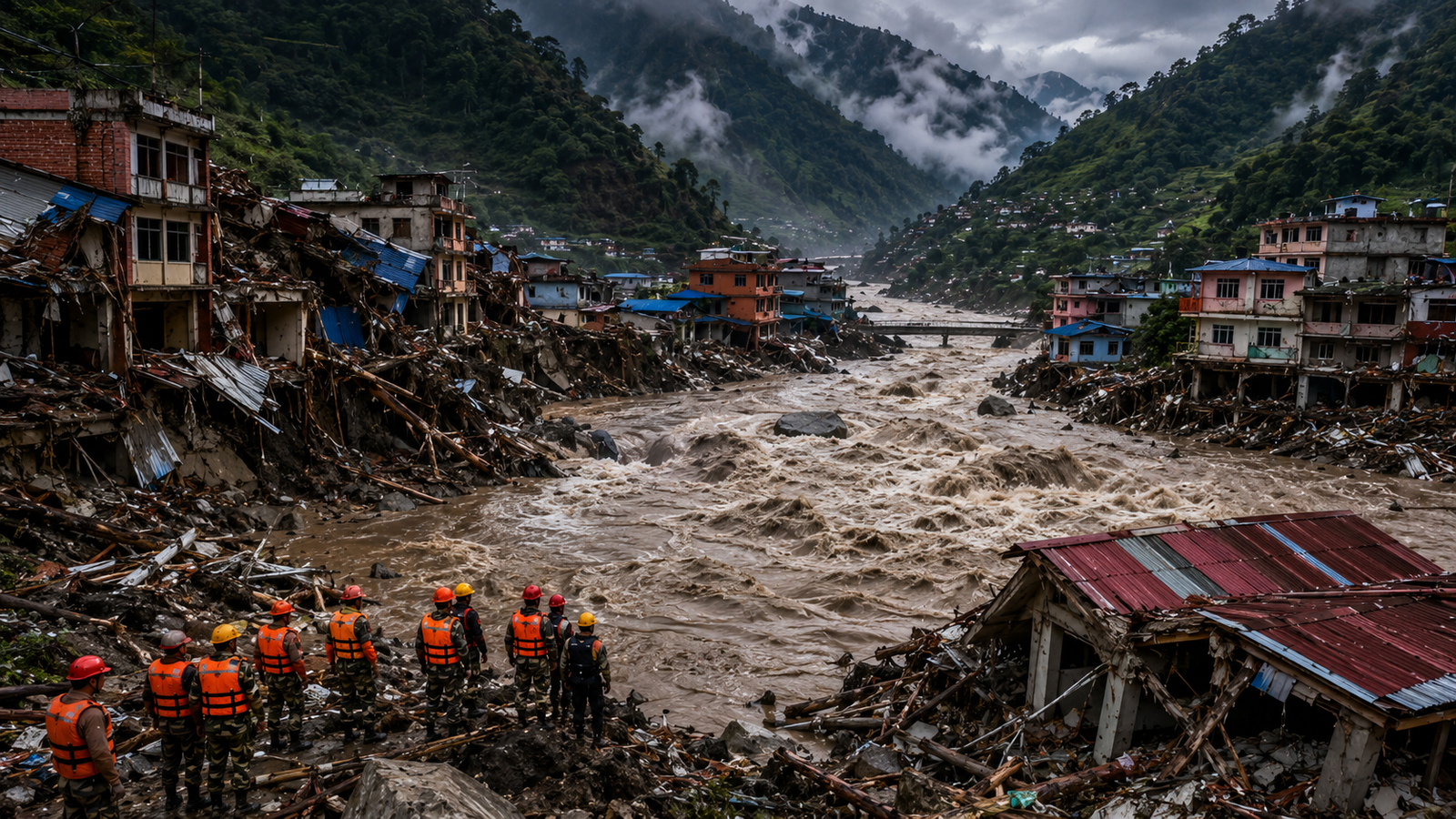
Kathmandu, August 30, 2026 — Nepal is facing one of its most devastating natural disasters in recent years after a sudden flash flood tore through Himalayan river valleys on August 26, killing hundreds of people and leaving thousands missing.
The disaster struck the northern Rasuwa region near the Nepal-China border before the floodwater surged downstream through the Bhote Koshi and Trishuli river systems. Entire settlements were damaged, roads and bridges were swept away, and critical hydropower and border infrastructure suffered extensive destruction.
By August 29, Nepalese authorities had reported hundreds of deaths and more than 2,400 people still unaccounted for, while thousands had been rescued. Search-and-rescue operations remain underway.
But the most important question is: what caused such a massive flood to appear with so little warning?
It Was Not a Normal Monsoon Flood
The disaster initially created confusion because an earthquake was suspected to have triggered the event.
However, subsequent geological analysis indicated that the catastrophic surge was associated with a sudden collapse of ice, rock and mountain debris in the high Himalayas. The collapse generated an enormous pulse of water and debris that entered the river system on the Tibetan side before rushing into Nepal.
Unlike a conventional monsoon flood, the event did not depend on hours of intense rainfall immediately upstream.
That distinction is crucial.
Traditional flood-warning systems generally monitor rainfall, river levels and weather conditions. A sudden collapse high in the mountains can occur without providing enough time for those systems to detect a conventional flood threat.
The result was what experts describe as a rapid-onset or “blue-sky” flood — a flood that can strike even when there is no obvious extreme rainfall at the affected location.
How the Flood Became So Destructive
The initial collapse released an enormous mixture of water, ice, rock, mud and other debris.
That material entered the Lhende/Bhote Koshi river system and moved downstream at extraordinary speed.
The surge then travelled through the Bhote Koshi and into the Trishuli, carrying destructive debris through narrow Himalayan valleys.
According to Nepal’s Flood Forecasting Division, authorities received information at around 9:05 a.m. on August 26 that a major flood surge had entered the Bhote Koshi from the Tibetan side. The water subsequently moved downstream through the Bhote Koshi and Trishuli before eventually spreading toward the Narayani system.
The geography of the Himalayas amplified the destruction.
Narrow valleys concentrate enormous volumes of water into relatively confined channels. When that water is mixed with boulders, mud, ice and trees, the result behaves less like an ordinary river flood and more like a rapidly moving wall of debris.
Why Was There So Little Warning?
One of the most frightening aspects of the disaster was the speed.
Reports indicate that the Trishuli River at some monitoring locations rose dramatically within minutes. The suddenness of the event left communities with little time to evacuate.
This exposes a major weakness in disaster preparedness across the Himalayas.
A warning system designed primarily around rainfall and river levels may struggle to detect a mountain collapse before the resulting flood has already entered the river system.
For people living downstream, even a warning issued after the collapse may arrive too late.
A Second Flood Threat Is Now Emerging
The immediate catastrophe may be over, but authorities remain concerned about another possible flood.
The original surge carried enormous quantities of rock and debris downstream. In places, this material has obstructed river channels and created temporary lakes.
Nepal’s Flood Forecasting Division warned on August 29 that a barrier lake upstream of the Bhote Koshi was expanding. If the natural barrier fails, water, rocks and debris could suddenly rush downstream again, creating another flash flood.
The possibility of a second surge is particularly dangerous because rescue teams and survivors are already operating in areas devastated by the first flood.
Authorities have therefore urged people to stay away from riverbanks and high-risk areas while the unstable lake and surrounding terrain are monitored.
Climate Change May Be Increasing the Risk
Scientists have long warned that warming temperatures are changing the Himalayan environment.
Glaciers are retreating in many parts of the region, while warming can destabilize ice, rock and frozen ground at high elevations.
That does not mean that climate change can automatically be identified as the sole cause of this particular flood. Investigations into the exact chain of events are still continuing.
But scientists are increasingly concerned that a warmer Himalayan environment could make certain types of glacial collapse, ice avalanches and glacial lake outburst floods more likely or more dangerous.
The distinction matters: the immediate trigger was a sudden mountain collapse and debris surge; climate change is a broader factor that may be altering the conditions under which such hazards occur.
The Human Cost
The disaster has devastated communities along the Bhote Koshi and Trishuli corridors.
Homes, markets, roads and bridges have been damaged or destroyed. Hydropower infrastructure has also suffered major losses.
The World Health Organization says that Rasuwa, Nuwakot, Dhading, Chitwan and parts of Gandaki Province have been affected, with around 10,000 households reported to need immediate relief. Several health facilities have also been damaged or isolated.
For survivors, the crisis is now shifting from immediate escape to survival and recovery.
Families are searching for missing relatives. Rescue teams are working through mud and debris. Damaged roads are making access difficult, while destroyed communications and infrastructure are complicating the response.
Nepal’s Economy Faces a Major Setback
The disaster is also expected to have a significant economic impact.
Nepal’s Finance Minister has estimated that reconstruction could require between $4 billion and $5 billion, potentially approaching a tenth of the country’s economy.
Hydropower infrastructure — one of Nepal’s most important economic sectors — has been particularly affected. Roads, bridges and other infrastructure connecting the Himalayan border regions have also suffered severe damage.
The disaster therefore represents more than a humanitarian emergency. It could become a major economic and infrastructure crisis.
The Bigger Warning for the Himalayas
The Nepal disaster is a reminder that Himalayan hazards are changing — and that conventional ideas about floods may no longer be enough.
A flood does not always begin with dark clouds and hours of heavy rain.
It can begin with an unstable glacier, an ice avalanche, a collapsing mountainside or a temporary natural dam.
And when those events occur in high, remote terrain, communities downstream may have only minutes to respond.
For Nepal, the challenge now is not only to rebuild what was destroyed but to improve how the country detects hazards that originate high above its river valleys.
Better satellite monitoring, high-altitude sensors, glacier surveillance, downstream sirens, cross-border data sharing and faster evacuation systems could all become increasingly important.
A Disaster That Began High Above the River
The waters that destroyed communities in Nepal on August 26 did not simply come from the monsoon.
They came from a chain reaction in one of the world’s most unstable and rapidly changing mountain environments — ice and rock collapse, debris movement, river blockage and a sudden downstream surge.
And with another unstable barrier lake being monitored upstream, the danger has not completely disappeared.
The Himalayan landscape may look permanent.
But beneath the snow and ice, it is constantly moving.
For the people living below it, understanding those movements could be the difference between receiving a warning — and having no warning at all.