

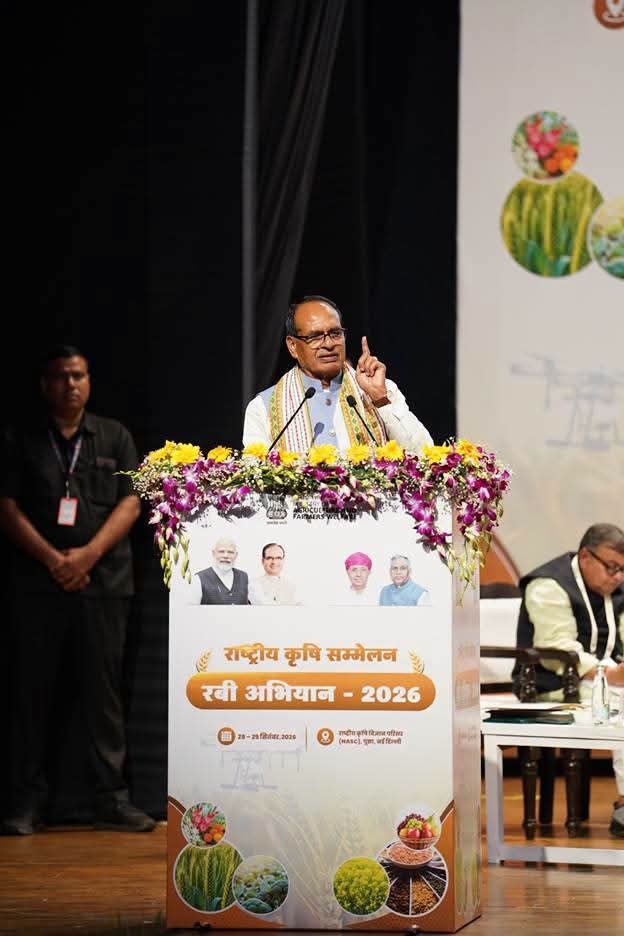
Shivraj Singh Chouhan calls for a “Team Agriculture” approach, fixed pre-season review dates and stronger coordination from the district level to the Centre
GTNS
NEW DELHI | SEPTEMBER 29, 2026 , India’s preparations for the upcoming Rabi season have moved towards a more coordinated framework, with Union Agriculture and Farmers’ Welfare Minister Shivraj Singh Chouhan calling for closer cooperation between the Centre, states, scientists, farmers and other stakeholders.
Addressing the second day of the National Agriculture Conference–Rabi Campaign 2026 in New Delhi on September 29, Chouhan said agricultural challenges should be addressed collectively rather than through political differences. He emphasised that governments may change, but the interests of the country and its farmers remain a continuing responsibility.
The conference also saw the distribution of sanction letters covering more than ₹1,200 crore under the Prime Minister Rashtriya Krishi Vikas Yojana (PM-RKVY) for 10 states. The approved amounts included ₹290 crore for West Bengal, ₹198 crore for Haryana, ₹181 crore for Chhattisgarh, ₹154 crore for Arunachal Pradesh, ₹114 crore for Bihar, ₹104 crore for Karnataka, ₹75 crore for Mizoram, ₹64 crore for Himachal Pradesh, ₹58 crore for Jharkhand and ₹43 crore for Punjab.
A calendar for advance farm planning
One of the major organisational decisions emerging from the conference is an annual calendar for preparing for the two major crop seasons.
For the Kharif campaign, district-level meetings are scheduled every year for May 10, followed by state-level meetings on May 17. For the Rabi campaign, district-level consultations will take place on September 10 and state-level meetings on September 17.
The Centre also plans regular virtual reviews with states to track implementation of agricultural programmes and identify problems before they affect farmers at the field level.
From government departments to farmers: “Team Agriculture”
The proposed coordination mechanism extends beyond government departments. State-level agriculture teams are expected to bring together ministers, senior officials, agricultural universities, ICAR institutions, Krishi Vigyan Kendras, ATMA, Farmer Producer Organisations, progressive farmers, processors and exporters.
At the district level, collectors, agriculture officials, KVKs, scientists, bankers and farmers are expected to participate in regular consultations. The objective is to connect policy decisions with actual field conditions.
The approach comes against a backdrop of increasing concerns over irregular rainfall, water availability and climate-related risks. Earlier in the conference, Chouhan had asked states to use soil-moisture and water-availability assessments while deciding Rabi crop plans.
Push for pulses, oilseeds and sustainable farming
The Centre has also placed greater emphasis on pulses and oilseeds, particularly in areas where water availability is limited. Chouhan called for crop diversification and greater use of natural and integrated farming practices.
A special focus has been proposed for rice-fallow areas of eastern India, including Odisha, Bihar, Jharkhand and West Bengal, where pulse cultivation after the paddy harvest could provide an additional cropping opportunity.
The minister also called for action against spurious fertilisers, sub-standard seeds and poor-quality pesticides, while asking states to eliminate forced tagging of agricultural inputs.
From production to markets
The conference also addressed the question of farmer returns after harvest. The Centre highlighted post-harvest management, scientific warehousing and improved marketing systems as part of its strategy.
Chouhan said the government would ensure procurement of tur, urad and masoor at MSP, with arrangements aimed at making payments to farmers within 48 hours. He also pointed to opportunities arising from international trade agreements for connecting Indian agricultural commodities with overseas markets.
The broader objective outlined at the conference was to combine higher farm production with better resource management, stronger institutional coordination and improved market access—an approach the minister described as necessary for building India into a major global food supplier.