

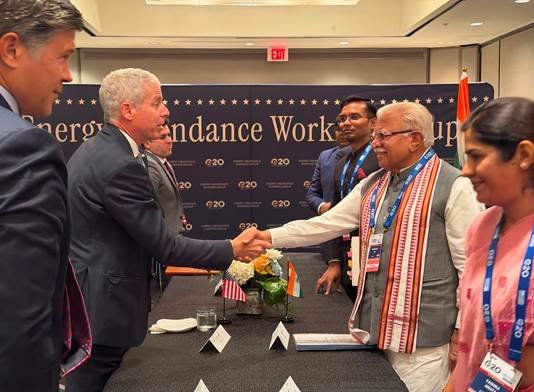
Power Minister Manohar Lal outlines India’s approach to reliable energy, faster project approvals and stronger mineral supply chains
GTNS, SEPTEMBER 17, 2026 , NEW DELHI — India has used a G20 ministerial meeting in the United States to underline the importance of dependable and affordable energy supplies while urging greater international cooperation on critical minerals and energy infrastructure.
Union Power Minister Manohar Lal represented India at the G20 Energy Abundance Ministerial Meeting, held in the US under the current G20 presidency. The discussions brought energy security, regulatory reform and supply-chain resilience into focus as countries seek to manage growing energy demand alongside their climate commitments.
For India, the discussions centred on a practical challenge: expanding access to electricity and modern energy while ensuring that the infrastructure supporting future growth remains resilient.
INDIA’S ENERGY TRANSITION
During the meeting, Lal highlighted the country’s expansion of its electricity system and India’s progress towards its climate-related commitments.
India has already reached several of the targets outlined in its Nationally Determined Contributions ahead of their original timelines, according to the government. The country continues to maintain its longer-term objective of achieving Net Zero emissions by 2070.
The minister also emphasised that India’s energy transition is being pursued alongside the need to maintain reliable power supplies for households, businesses and emerging sectors of the economy.
CRITICAL MINERALS GAIN IMPORTANCE
Critical minerals formed another important part of India’s intervention.
Minerals required for batteries, renewable-energy equipment, electronics and other advanced technologies have become increasingly important to the global energy transition. India highlighted its efforts under the National Critical Mineral Mission to strengthen the domestic mineral ecosystem, covering areas such as exploration, processing, recycling and value addition.
Lal called for international cooperation that can make mineral supply chains more diversified and resilient while encouraging recycling and greater processing capacity.
The discussions reflect a wider shift in energy policy, where access to fuel and electricity is increasingly connected with access to the raw materials needed to build modern energy technologies.
FOCUS ON REGULATORY EFFICIENCY
India also presented its experience with digital and institutional mechanisms aimed at making infrastructure approvals more efficient.
Initiatives including the National Single Window System, PARIVESH and PM Gati Shakti were highlighted in the context of improving coordination and reducing delays in infrastructure development.
For a rapidly expanding economy, faster project clearances can influence the pace at which power-generation, transmission and other energy infrastructure are added.
CLEAN COOKING ON G20 AGENDA
The meeting also addressed access to clean cooking.
G20 discussions supported efforts to expand clean-cooking access while recognising that countries have different energy circumstances, technologies and affordability requirements.
The group also advanced cooperation on regulatory permitting and water reuse, areas that can influence the cost and speed of energy and infrastructure projects.
BILATERAL ENERGY ENGAGEMENT
On the sidelines of the meeting, Lal held discussions with senior US and Canadian officials, including US Energy Secretary Chris Wright, US Interior Secretary Doug Burgum and Corey Hogan, Parliamentary Secretary to Canada’s Minister of Energy and Natural Resources.
The conversations covered energy cooperation, resilient supply chains and the changing requirements of power systems as economies become increasingly dependent on digital technologies.
The G20 meeting has consequently brought together several issues that are becoming closely linked in the global energy debate: energy affordability, reliability, clean technologies, critical minerals, infrastructure approvals and supply-chain security.
For India, the message at the ministerial forum was that the transition to a lower-carbon energy system must also address the fundamental requirement of keeping energy available, dependable and affordable for a growing economy.
Global Times News | INDIA ; GTNS