

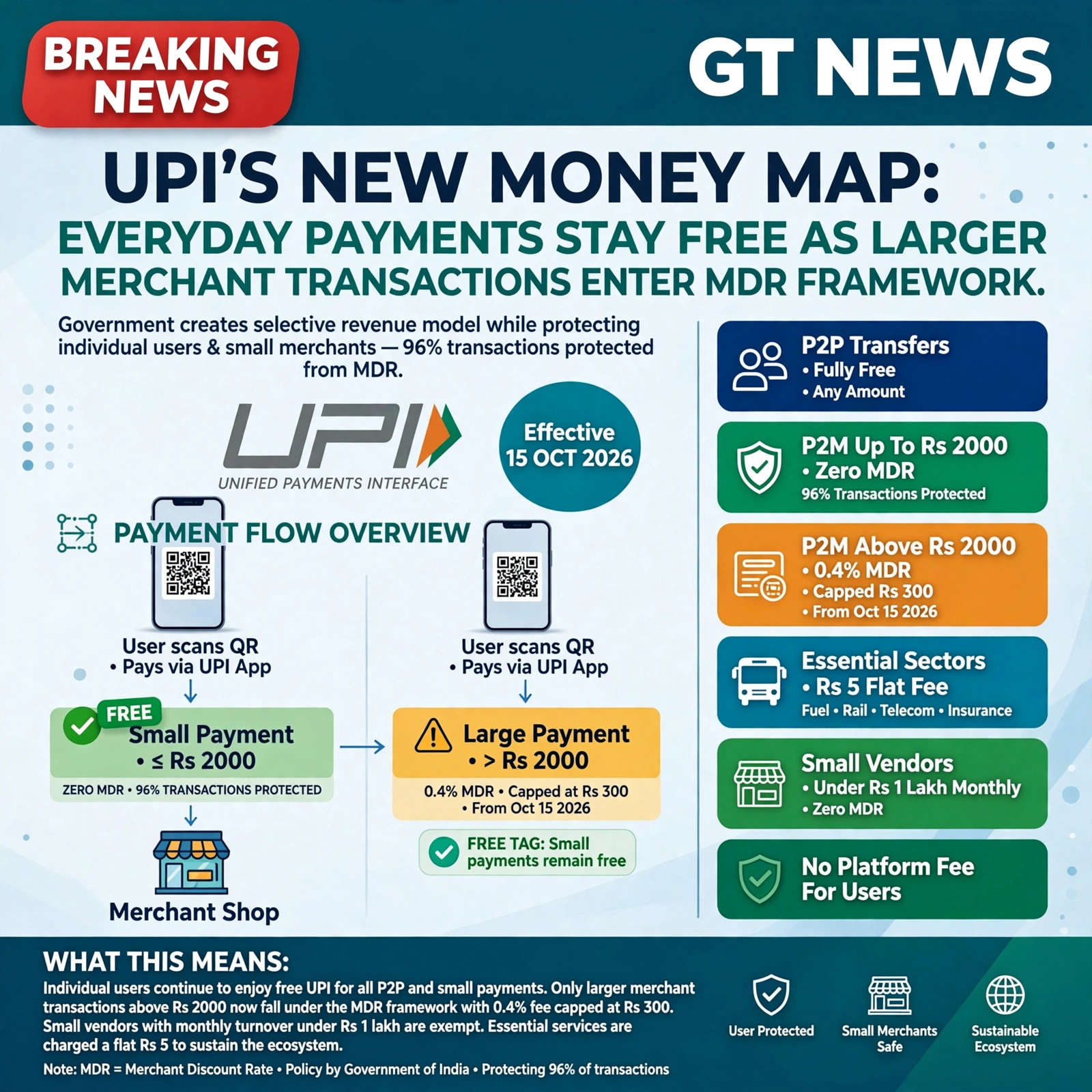
Government creates a selective revenue model for UPI while protecting individual users, small merchants and nearly 96% of merchant transactions from MDR
GTNS ,SEPTEMBER 16, 2026 , NEW DELHI: India’s UPI payment system is moving into a new phase where the focus is no longer simply on expanding digital payments, but also on creating a financial model to support the infrastructure behind them.
The Centre has clarified that the new framework will not introduce charges on person-to-person UPI payments. At the same time, a limited Merchant Discount Rate (MDR) will apply to specified higher-value payments made to merchants.
The government says the framework is designed to balance two objectives: keeping everyday digital payments affordable while creating a revenue mechanism for the banks, payment service providers and application providers that operate the UPI ecosystem.
THE BIG DIVIDE: PEOPLE VS. MERCHANT PAYMENTS
The new structure creates a clear distinction between two types of UPI transactions.
When money moves from one individual to another, there will be no MDR or other transaction charge, irrespective of the amount.
The same zero-charge principle applies to merchant payments up to ₹2,000.
According to the Finance Ministry, P2P transactions represent about 70% of UPI transaction value, keeping a major portion of the digital-payment ecosystem completely outside the MDR framework.
WHERE THE NEW CHARGE BEGINS
The MDR mechanism comes into play only for specified person-to-merchant transactions above ₹2,000.
The standard MDR has been fixed at 0.4%.
For transactions worth ₹75,000 or more, however, the MDR will not continue rising indefinitely. It will be capped at ₹300 per transaction.
The government has clarified that MDR is not a government tax and is not collected by the government or NPCI. Instead, it is distributed among participants in the payment ecosystem, including banks, payment service providers and UPI application providers.
96% OF MERCHANT PAYMENTS OUTSIDE THE NEW MDR
The headline figure in the new framework is not the 0.4% rate but the proportion of transactions that will remain untouched.
Government analysis indicates that MDR will apply to only around 4% of merchant transactions.
Consequently, approximately 96% of P2M transactions will remain unaffected, either because they are below the ₹2,000 threshold or because they fall under the zero-MDR provisions for small merchants.
This makes the framework considerably narrower than a blanket charge on merchant UPI payments.
SMALL SHOPS AND STREET VENDORS GET A SEPARATE SHIELD
The framework also creates protection for smaller businesses.
Small merchants, including street vendors and neighbourhood shops, receiving up to ₹1 lakh per month through UPI QR codes under the specified P2PM category will continue to receive zero-MDR treatment.
The provision is aimed at keeping payment costs away from businesses operating on smaller margins.
CUSTOMERS ARE NOT SUPPOSED TO PAY MDR
Another important feature is who actually bears the MDR.
The government has explicitly stated that MDR is not a charge on the customer.
Banks have been advised to ensure that merchants do not transfer the MDR cost to consumers. UPI application providers are also prohibited from imposing platform fees or hidden charges on individuals under the framework.
That means a customer paying a merchant through UPI should not be presented with a separate MDR bill.
ESSENTIAL SERVICES GET A FLAT-RATE MODEL
The framework does not apply exactly the same MDR structure to every sector.
For specified essential and thin-margin sectors—including railways, telecommunications, insurance, fuel and agricultural inputs—transactions above ₹2,000 will attract a flat ₹5 MDR per transaction.
The government says this structure is intended to provide greater cost certainty for essential services and businesses operating with narrower margins.
CAPITAL MARKET PAYMENTS GET LOWER MDR
A separate rate has also been prescribed for certain capital-market transactions.
Payments involving mutual funds, securities, stockbrokers and dealers will attract an MDR of 0.02%, subject to a maximum of ₹300 per transaction.
The lower rate distinguishes financial-market payments from ordinary higher-value merchant transactions.
WHY THE SYSTEM NEEDS A REVENUE MODEL
UPI has grown into critical national digital infrastructure, requiring continuous investment in technology, cybersecurity, fraud prevention, payment processing and network expansion.
The government says revenue from selected larger merchant transactions will help payment ecosystem participants maintain and expand that infrastructure, including in rural and semi-urban areas.
The new framework therefore attempts to create a revenue stream without placing a general transaction fee on individuals.
A NEW FUND FOR SMALL-MERCHANT ADOPTION
The framework also provides for a dedicated fund to encourage UPI adoption among small merchants.
An amount equivalent to 5% of total MDR collections will be contributed to the fund.
The stated objective is to encourage wider acceptance and continued use of digital payments among smaller businesses.
NO MONTHLY FEE OR FREE-TRANSACTION QUOTA FOR INDIVIDUALS
The Finance Ministry has also clarified that individuals will continue to have unlimited free UPI usage.
There will be no monthly quota, volume-based fee or tiered charge for individuals under this framework.
Existing daily transaction limits imposed by banks and NPCI—generally ranging from ₹1 lakh to ₹5 lakh depending on the category—are described as security and risk-management measures, rather than charging thresholds.
FROM DIGITAL REVOLUTION TO SUSTAINABLE INFRASTRUCTURE
The latest framework marks a broader development in India’s digital-payment story.
The first phase of UPI was about getting people and businesses onto a common digital payment network. The next phase increasingly concerns how that network can remain financially sustainable while continuing to offer low-cost access.
The government says the framework was introduced under the Payment and Settlement Systems Act, 2007, following deliberations by the UPI Steering Committee on rates, operational arrangements and consumer safeguards.
The result is a three-layer system: individual-to-individual payments remain free, small-value and protected merchant transactions largely remain outside MDR, while selected larger commercial transactions contribute to the cost of maintaining the payment ecosystem.
For India’s millions of UPI users, the practical message remains simple: sending money to another person stays free, and customers are not supposed to pay MDR.
For the payment industry, however, the new framework signals the beginning of a more structured revenue model for sustaining one of India’s most widely used digital-payment networks.