

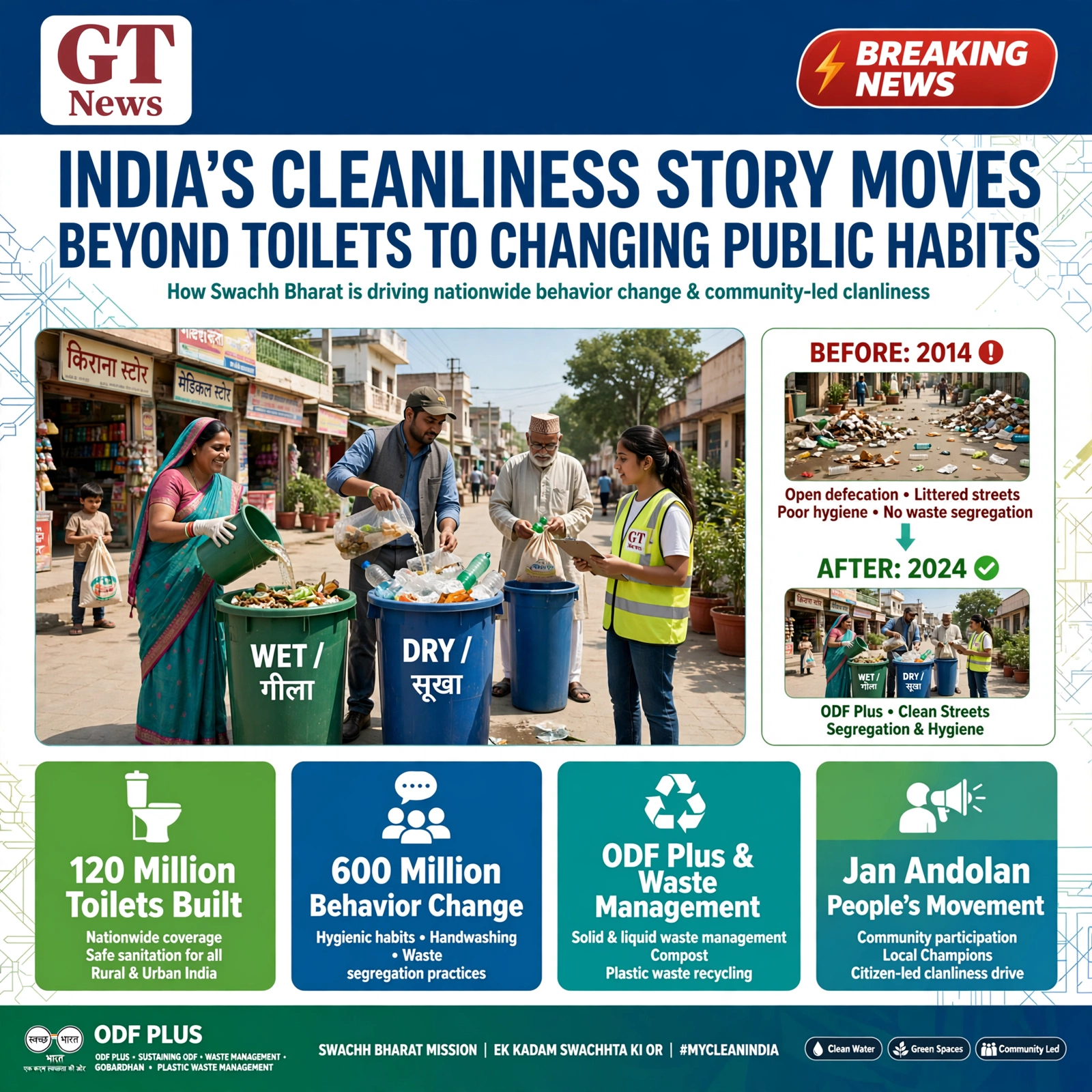
Dr Jitendra Singh highlights the shift from sanitation infrastructure to a growing sense of civic responsibility under the Swachhata campaign
GTNS ,SEPTEMBER 16, 2026 ,NEW DELHI: India’s cleanliness campaign is increasingly entering a different phase—one in which the success of sanitation efforts is being reflected not just in physical infrastructure, but in how people behave in public spaces.
Union Minister of State Dr Jitendra Singh highlighted this change while recalling the early focus of the government on Swachhata, saying the campaign began by addressing basic sanitation needs and has since produced a wider impact on public awareness.
THE FIRST CHANGE WAS AT HOME
When the cleanliness drive gathered momentum, sanitation infrastructure was one of its most visible priorities.
Dr Singh recalled that about four lakh toilets were constructed during the first year, particularly helping address sanitation and safety concerns faced by women in rural areas.
The emphasis was significant because access to sanitation is closely connected with dignity, safety and everyday quality of life.
THE SECOND CHANGE IS IN THE STREET
The more difficult part of a cleanliness campaign begins after infrastructure is created.
According to Dr Singh, people today are increasingly conscious of littering in public places.
That represents a shift from seeing cleanliness primarily as the responsibility of government departments to recognising it as a shared civic responsibility.
A person deciding not to throw waste on a road may appear to be a small individual action, but repeated across millions of people, such behaviour can influence the cleanliness of entire communities.
WHEN A CAMPAIGN BECOMES A HABIT
The Swachhata campaign’s broader significance lies in this transition.
Government programmes can create facilities, organise drives and build awareness. Sustained cleanliness, however, depends heavily on what citizens do after those campaigns and programmes are over.
The behavioural change highlighted by Dr Singh suggests that the cleanliness message has increasingly entered everyday public consciousness.
A GOVERNANCE ISSUE WITH A DAILY IMPACT
Cleanliness may appear to be a basic civic issue, but its consequences extend into public health, sanitation, women’s dignity and the quality of shared spaces.
That is why the campaign was presented from the beginning as more than a conventional government programme.
Dr Singh said the early focus on Swachhata also reflected an approach to governance centred on issues directly affecting ordinary citizens.
FROM NUMBERS TO SOCIAL CHANGE
The number of toilets constructed provides one measurable indicator of progress.
Changing attitudes towards littering provides another—and potentially more difficult one to measure.
The distinction is important. Infrastructure can be built within a defined period; changing public habits requires sustained awareness and participation.
The government’s assessment, as expressed by Dr Singh, is that the cleanliness campaign has increasingly produced that second form of change.
THE NEXT TEST IS CONSISTENCY
The long-term challenge will be maintaining these habits across public spaces, institutions, markets, roads and neighbourhoods.
Greater awareness can become meaningful only when it translates into consistent daily action.
The Swachhata campaign therefore represents two connected journeys: first, expanding sanitation facilities; and second, encouraging citizens to take greater ownership of cleanliness.
The government’s cleanliness message may have started with toilets and sanitation, but its larger test now lies in whether the habit of keeping public spaces clean continues from one generation to the next.
GLOBAL TIMES NEWS | INDIA