

Long-pending Tons River project clears a major hurdle as six Yamuna-basin states sign agreement with 90% central funding
GTNS , SEPTEMBER 16, 2026 , NEW DELHI: A project that remained trapped for years in the complex politics of interstate water-sharing has now moved into a new phase.
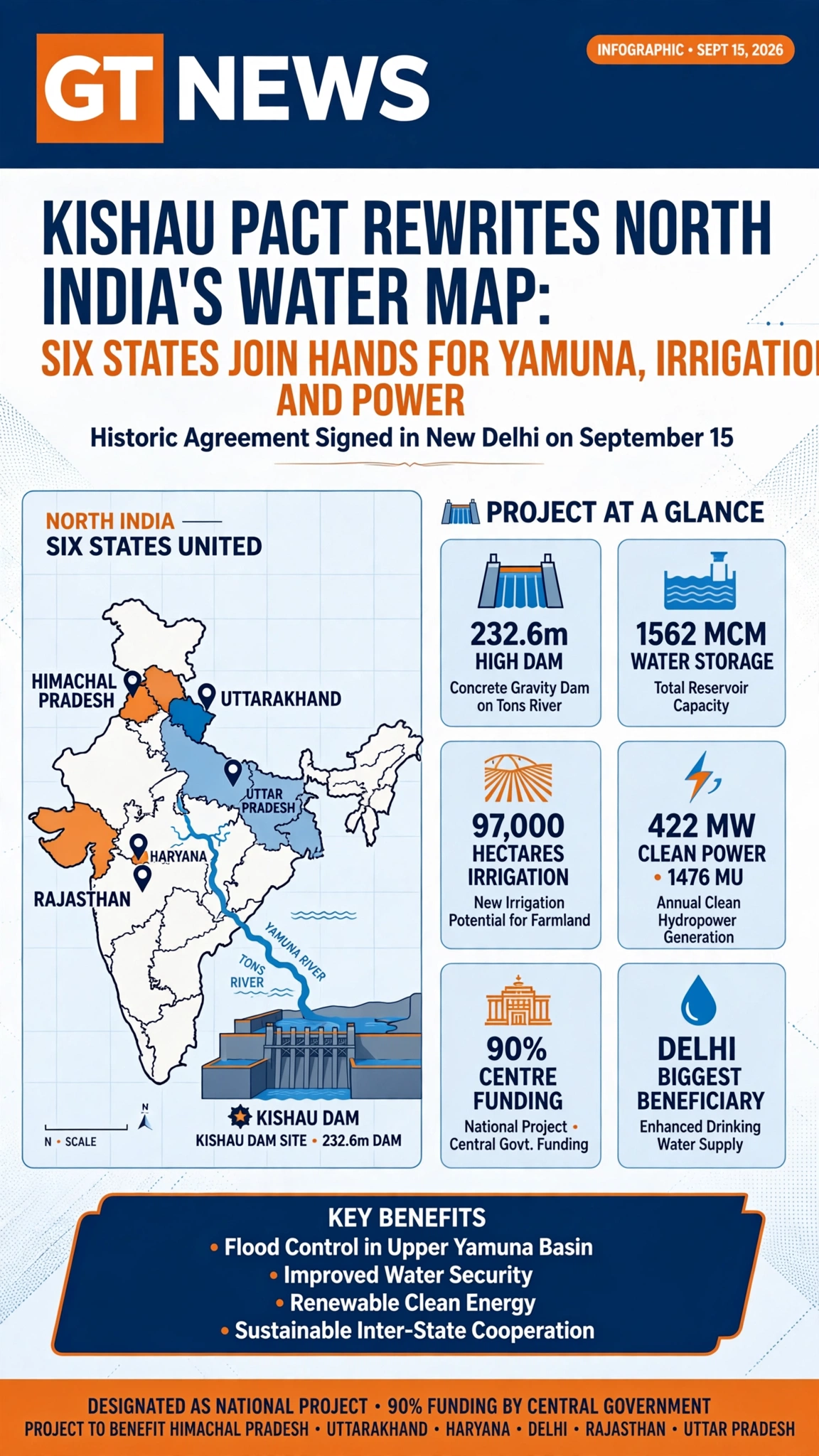
The Chief Ministers of Uttar Pradesh, Uttarakhand, Himachal Pradesh, Haryana, Rajasthan and Delhi have signed the Kishau Multipurpose Project agreement, bringing six Yamuna-basin states onto a common framework for one of North India’s major planned water infrastructure projects.
The agreement was signed in the presence of Union Home and Cooperation Minister Amit Shah and Union Jal Shakti Minister C. R. Patil in New Delhi on September 15.
WHY KISHAU MATTERS BEYOND ONE DAM
The Kishau project is planned on the Tons River, which flows along the Uttarakhand-Himachal Pradesh border.
Its importance goes beyond the location of the proposed dam. The project is designed to connect several requirements—water storage, irrigation, hydropower and downstream water availability—within a single interstate framework.
The proposed concrete gravity dam will be approximately 232.6 metres high, with a planned storage capacity of around 1,562 million cubic metres. The project is expected to irrigate approximately 97,000 hectares and generate around 1,476 million units of clean hydropower.
That makes the agreement significant for states with very different water requirements but a common connection through the Yamuna basin.
THE DELHI-YAMUNA CONNECTION
One of the most closely watched aspects of the agreement is its potential impact on Delhi and the Yamuna.
According to the Union government, the project is expected to increase water availability in the Yamuna system and contribute to environmental conservation. The Centre has said that around 25 per cent of the water will become available through the Kishau agreement, with Delhi identified as a major beneficiary.
The project’s significance therefore extends beyond drinking-water and irrigation calculations.
For Delhi, the Kishau arrangement is being linked to the larger effort to improve the condition of the Yamuna.
90% OF THE WATER COMPONENT TO BE FUNDED BY CENTRE
The financial structure has also helped create the framework for consensus.
Kishau has been declared a National Project, with approximately 90 per cent of the financial burden for the water component to be borne by the Government of India. The remaining 10 per cent will be shared by the participating states in accordance with the agreed arrangement.
The June 2026 consensus had also provided for Himachal Pradesh’s allocated water share to be made available to Delhi and Rajasthan, in return for sharing the cost associated with Himachal Pradesh’s portion of the project’s power component.
That arrangement was important in bridging the interests of the participating states.
FROM 1994 UNDERSTANDING TO 2026 AGREEMENT
The Kishau story is not new.
The Union government has traced the present agreement to a 1994 arrangement under which separate agreements were to be reached for individual storage projects in the basin.
According to the government, progress on Kishau accelerated after agreements on other projects, including Lakhwar and Renukaji, helped change the broader interstate water-sharing landscape. A formal consensus on Kishau was reached in June 2026, followed by the agreement signed on September 15.
The latest signing therefore represents the culmination of negotiations stretching across decades rather than a newly conceived project.
SIX STATES, DIFFERENT NEEDS, ONE WATER SYSTEM
The six participating states bring different priorities to the table.
For Himachal Pradesh and Uttarakhand, the project is connected to the upper reaches of the Tons and the generation of hydropower.
For Uttar Pradesh and Haryana, the project has implications for irrigation and water availability within the wider Yamuna basin.
For Rajasthan, the agreement has relevance to its allocated water share.
For Delhi, the focus is particularly tied to water availability and the Yamuna.
The challenge—and the central purpose of the agreement—is to make these different interests work within one project framework.
KISHAU BECOMES PART OF A LARGER WATER-CONSENSUS PUSH
The Centre is presenting the agreement as the latest in a series of efforts to resolve long-pending interstate water issues through negotiations.
According to Amit Shah’s remarks recorded by PIB, the government considers Kishau the tenth water-related dispute or issue since 2018 to reach a resolution under this broader consensus-building approach. The government has cited agreements involving Lakhwar, Shahpur Kandi, Renukaji, Ken-Betwa and other water-related matters as part of the sequence.
This gives the Kishau agreement a significance beyond the project itself: it becomes another test of whether interstate water disputes can be moved from prolonged negotiations to implementation through negotiated settlements.
THE NEXT BATTLE IS IMPLEMENTATION
The signing of the agreement removes a major political and administrative hurdle, but the project now faces the more difficult implementation stage.
The Centre and the six states will have to translate the agreement into project execution, including the necessary approvals, financing arrangements, construction and inter-state coordination.
The June agreement had stated that after the MoU, the project would be placed before the Union Cabinet for approval.
The success of Kishau will ultimately be measured not by the signing ceremony but by whether the promised water, irrigation, power and environmental benefits materialise on the ground.
FROM THE TONS TO THE YAMUNA
The Kishau agreement creates a long chain of intended benefits: storage in the upper basin, power generation, irrigation across nearly one lakh hectares and additional water availability downstream.
For six states, it is an interstate water-sharing arrangement.
For Delhi, it is closely connected with the Yamuna.
And for the Centre, it is a test of whether years of negotiation can now be converted into infrastructure and measurable public benefit.
The agreement has been signed. The next chapter is implementation.
GLOBAL TIMES NEWS | INDIA