

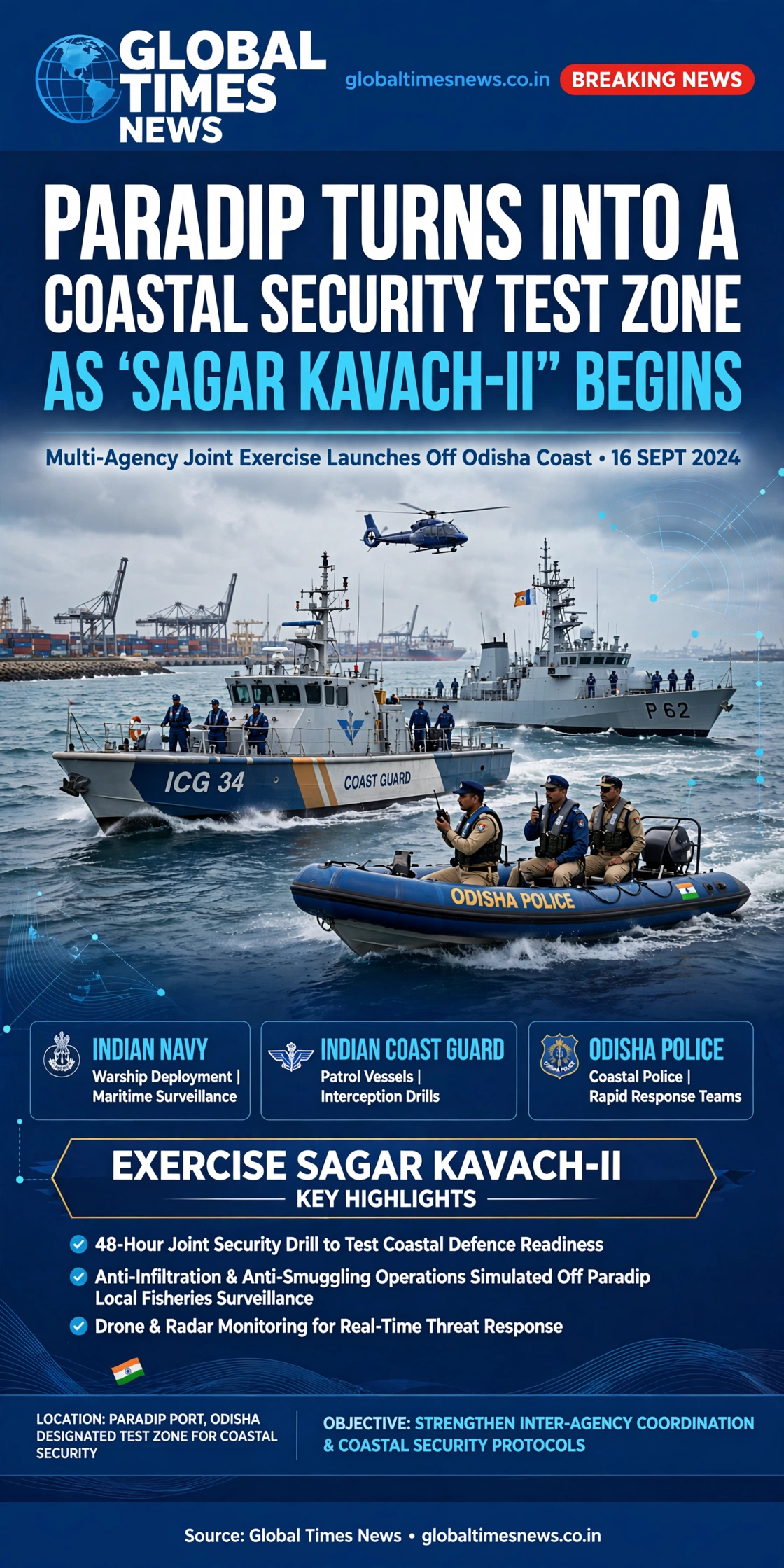
Two-day multi-agency exercise puts Odisha’s maritime security preparedness, coordination and rapid response systems to the test
GTNS, SEPTEMBER 16, 2026, PARADIP: Odisha’s maritime security preparedness has come under a major operational test with the launch of the two-day joint coastal security exercise ‘Sagar Kavach-II’ at Paradip, bringing more than 18 key departments and security agencies together to simulate possible threats from the sea and assess the effectiveness of the coastal security network.
Rather than being confined to a conventional maritime drill, the exercise is designed to test how quickly multiple agencies can detect, communicate, coordinate and respond when a security threat moves from the sea towards the coastline and sensitive locations on land.
The exercise involves the Indian Navy, Indian Coast Guard, Marine Police, Odisha Police, Central Industrial Security Force (CISF), Customs, Fisheries Department, Intelligence agencies, National Disaster Response Force (NDRF) and Forest Department, among other participating agencies.
A simulated threat from sea to land
One of the central features of the exercise is the division of participating personnel into two operational groups — the Red Team and Blue Team.
The Red Team is assigned the role of potential infiltrators or terrorists attempting to enter through maritime and land routes. Its simulated movements are intended to create situations resembling a real security challenge.
The Blue Team, meanwhile, is tasked with detecting, intercepting, responding to and neutralising the simulated threat across the deep-sea and coastal areas.
The arrangement allows security agencies to test their response mechanisms under conditions that are closer to a real-time security emergency rather than relying solely on routine preparedness checks.
Paradip and sensitive coastal locations under surveillance
As part of the exercise, heightened surveillance is being maintained around critical infrastructure, hotels, landing points, boat locations and other coastal areas.
The focus extends beyond the waterline because a maritime security breach can potentially develop into a wider security situation once an intruder reaches the shoreline.
The exercise therefore provides participating agencies with an opportunity to examine how maritime surveillance connects with policing, intelligence gathering, disaster response, infrastructure protection and local-level security operations.
Coordination emerges as the key test
With more than 18 agencies participating, one of the most important objectives of ‘Sagar Kavach-II’ is to examine the effectiveness of inter-agency coordination and communication.
A coastal security response involves multiple layers of responsibility. Information detected at sea may need to be passed rapidly to coastal security agencies, police units and other authorities on land.
The exercise is consequently being used to test communication channels, information sharing, mobilisation procedures and the ability of different agencies to operate together during a developing security situation.
Lessons from 26/11 remain central to maritime preparedness
The emphasis on coastal security exercises gained renewed importance following the November 26, 2008 Mumbai terror attacks, in which terrorists used the maritime route to reach Mumbai.
Since then, strengthening coastal surveillance, maritime domain awareness and coordination among agencies has remained an important component of India’s security preparedness.
Exercises such as ‘Sagar Kavach’ provide an operational platform for agencies to identify possible gaps in their response systems and improve preparedness before an actual emergency occurs.
From the deep sea to the coastline
The significance of the Paradip exercise lies in its integrated approach. The drill is not simply testing the ability of security forces to detect a suspicious movement at sea; it is also examining what happens after a potential threat reaches the coastal zone.
That makes the exercise a test of the entire chain — detection, communication, interception, coordination and response.
For Odisha, whose coastline includes important maritime infrastructure and coastal communities, maintaining effective coordination between central security agencies, state police, specialised forces and civilian departments remains a critical part of maritime preparedness.
A real-time rehearsal for an evolving threat
As ‘Sagar Kavach-II’ continues over the two-day period, the simulated Red Team activity and Blue Team response will provide participating agencies with an opportunity to assess their operational readiness under changing circumstances.
The broader objective is clear: to ensure that a potential maritime security threat does not become a larger coastal security crisis because of delays in detection, communication or coordination.
The Paradip exercise therefore serves as a real-time rehearsal of Odisha’s multi-layered coastal security response, bringing agencies operating at sea and on land into a single coordinated preparedness framework.